About Emerald
Be3Al2Si6O18
Emerald is the green to bluish-green variety of beryl. Its colour comes from trace chromium and/or vanadium, with iron influencing the exact shade; paler material is sold as green beryl, and the boundary is set by comparison stones in gem laboratories. Eye-visible inclusions (the garden-like 'jardin') are typical, and Colombian stones often contain three-phase inclusions of a salt crystal, liquid and a gas bubble. Lab-grown emerald has essentially the same chemical, physical and optical properties as natural emerald.
Photos of Emerald
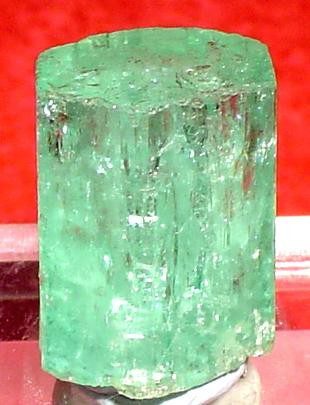
Light green, partly gemmy emerald crystal of about 1.7 cm from the Coscuez Mine.
Photo: Robert M. Lavinsky · CC BY-SA 3.0 · Source

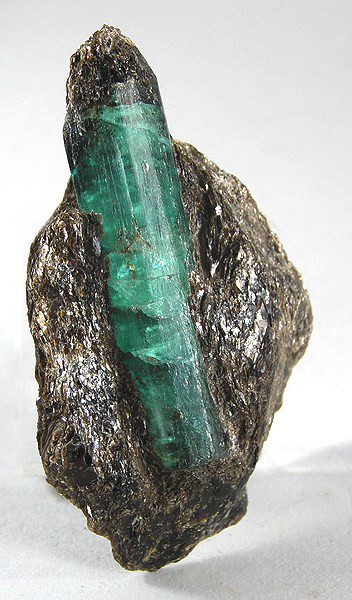
Bright green emerald crystal of 4.3 cm in schist matrix from the Panjshir Valley.
Photo: Robert M. Lavinsky · CC BY-SA 3.0 · Source

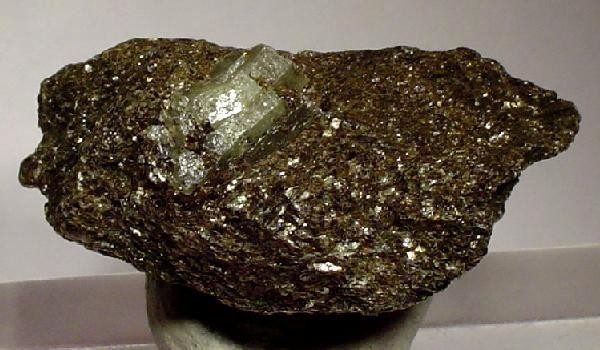
Light green emerald crystal of 1.5 cm on mica schist, an old specimen from the Habach valley.
Photo: Robert M. Lavinsky · CC BY-SA 3.0 · Source

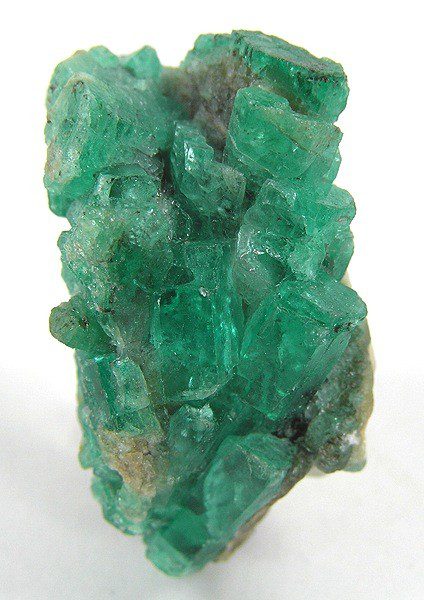
Cluster of about two dozen bright green emerald crystals up to 1.2 cm from Serra das Eguas, Brumado.
Photo: Robert M. Lavinsky · CC BY-SA 3.0 · Source

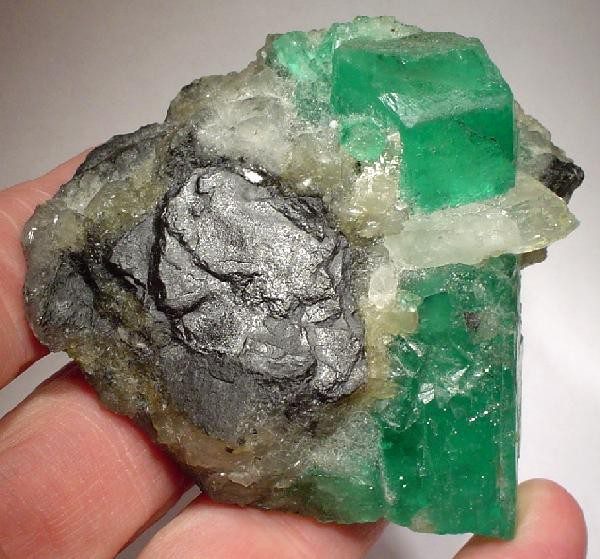
A 6 cm emerald crystal set in calcite and shale matrix from the Muzo Mine.
Photo: Robert M. Lavinsky · CC BY-SA 3.0 · Source

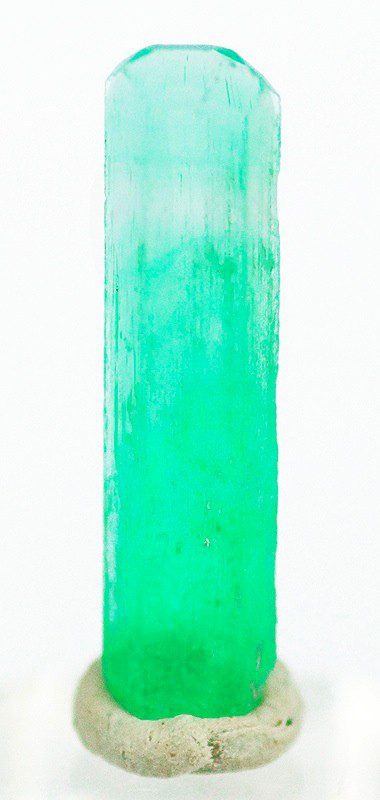
Light green emerald crystal of 2.7 cm with a modified pinacoid termination from Jos, Nigeria.
Photo: Robert M. Lavinsky · CC BY-SA 3.0 · Source

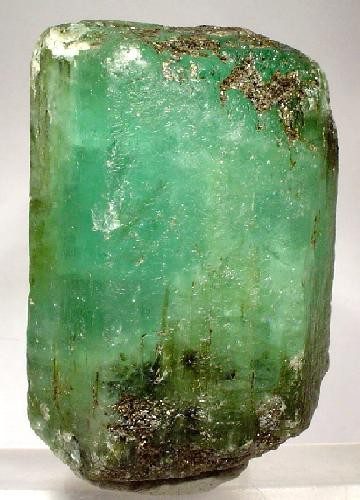
Large doubly terminated emerald crystal with embedded mica from Malyshevo, Urals.
Photo: Robert M. Lavinsky · CC BY-SA 3.0 · Source

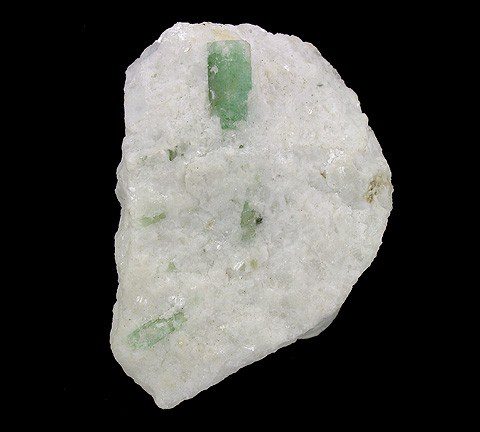
Light green prismatic emerald crystals up to 11 mm on matrix from Pizzo Marcio, Vigezzo valley.
Photo: Robert M. Lavinsky · CC BY-SA 3.0 · Source

Where Emerald is found (12)
Afghanistan
- Panjshir Valley emerald depositsPanjshir · 5 photos
Australia
- Specimen Hill (Torrington)New South Wales · 1 photo
Austria
- Habach valley (Habachtal), Hohe TauernSalzburg · 5 photos
Brazil
- Carnaiba emerald mines (Serra da Carnaiba, Pindobacu)Bahia · 3 photos
- Itabira emerald districtMinas Gerais · 1 photo
- Serra das Eguas (Brumado)Bahia · 4 photos
Colombia
- Chivor MineBoyacá · 1 photo
- Coscuez MineBoyaca · 5 photos
- Muzo MineBoyaca · 4 photos
Italy
- Pizzo Marcio emerald pegmatites (Trontano)Piemonte · 4 photos
Nigeria
- Jos PlateauPlateau State · 4 photos
Russia
- Malyshevo emerald mines (Malyshevskoe deposit, Mariinsky mine)Sverdlovsk Oblast · 4 photos
Identity
- Variety of
- Beryl
- Strunz
- 9 Silicates
- IMA status
- Variety
- Elements
- Be, Al, Si, O
Physical properties
- Color
- Green to bluish green; material too light in tone is called green beryl rather than emerald
- Streak
- White
- Luster
- Vitreous luster
- Transparency
- Variable
- Mohs hardness
- 7.5–8
- Density
- 2.63–2.97 g/cm³
- Cleavage / fracture
- Imperfect cleavage on {0001}; conchoidal to uneven fracture; brittle
Crystallography
- Crystal system
- Hexagonal
- Space group
- P6/mcc
- Typical habit
- Hexagonal prisms, commonly with a flat pinacoid termination; also columnar or granular masses (beryl habits)
- Twinning
- Rare
- Optical data
- Uniaxial (-); nω = 1.567-1.610, nε = 1.565-1.599 for beryl, rising with alkali content; pleochroism weak to distinct
Formation and use
- Formation
- Beryl forms in granites and granite pegmatites, in mafic metamorphic rocks and in low- to high-temperature hydrothermal veins; emerald forms where chromium and/or vanadium are available to the growing beryl. Colombian deposits (Muzo, Chivor) are classic sources of exceptional green crystals.
- Uses
- Gemstone; mineral specimens
- Stability and care
- More brittle than corundum, and nearly all emeralds contain fractures, so stones can be damaged in cutting, setting and wear. An estimated 99% of cut emeralds are clarity-enhanced by filling surface-reaching fissures with oil (traditionally cedarwood oil) or resins; these fillers can leak or dry out, so avoid ultrasonic cleaners, hot or soapy water and solvents such as acetone or alcohol.
Related minerals
- Related minerals
- Beryl
Sources
- SRC-266 · Book
Handbook of Mineralogy - BerylAnthony, J.W.; Bideaux, R.A.; Bladh, K.W.; Nichols, M.C. · 2001 · Mineralogical Society of America / Mineral Data Publishing - SRC-813 · Website
Emerald Gemstone | Emerald Stone - GIAGemological Institute of America · GIA Gem Encyclopedia - SRC-814 · Website
Emerald Quality FactorsGemological Institute of America · GIA Gem Encyclopedia - SRC-815 · Website
A Guide to Emerald EnhancementsBergman, J. · 2021 · International Gem Society
Draft data from the Provenite workbook. Check entries against the cited sources before relying on them. Photos are open-licence images from Wikimedia Commons; the author and licence are given with each photo.