About Albite
NaAlSi₃O₈
The sodium end member of the plagioclase feldspars and one of the commonest rock-forming minerals. Collectors know it mostly as white, platy to bladed cleavelandite that forms the matrix of gem tourmaline, beryl, topaz and garnet in granite pegmatites; clear single crystals are rare.
Photos of Albite
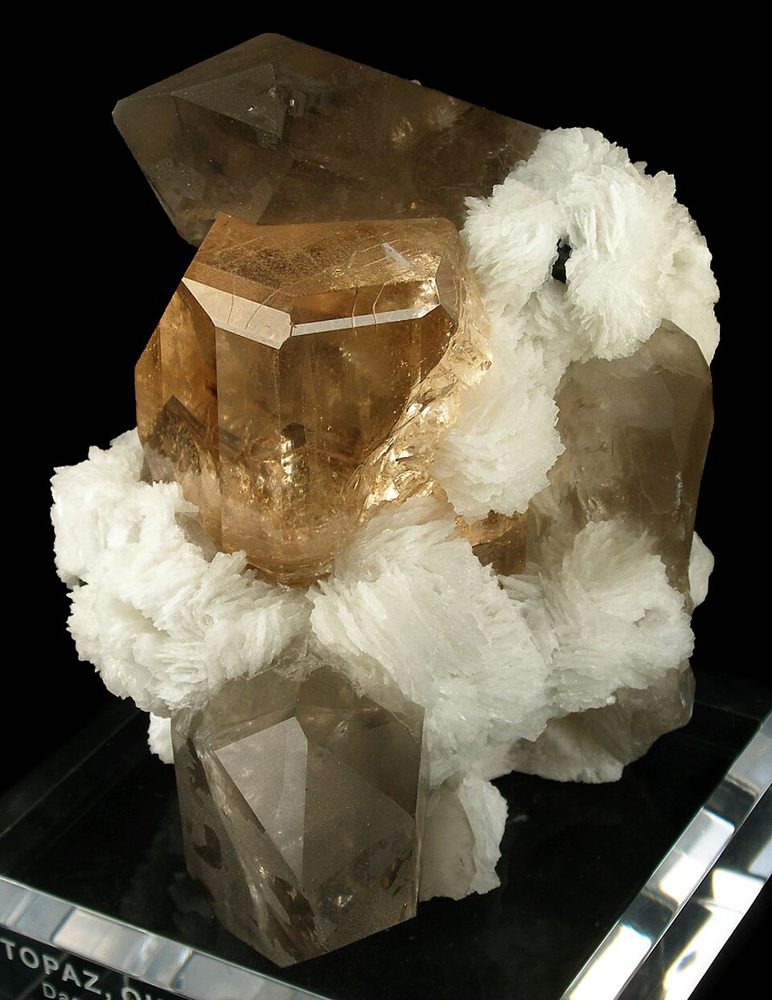
Transparent topaz with quartz nestled in crystallized cleavelandite, Dassu.
Photo: Robert M. Lavinsky · CC BY-SA 3.0 · Source

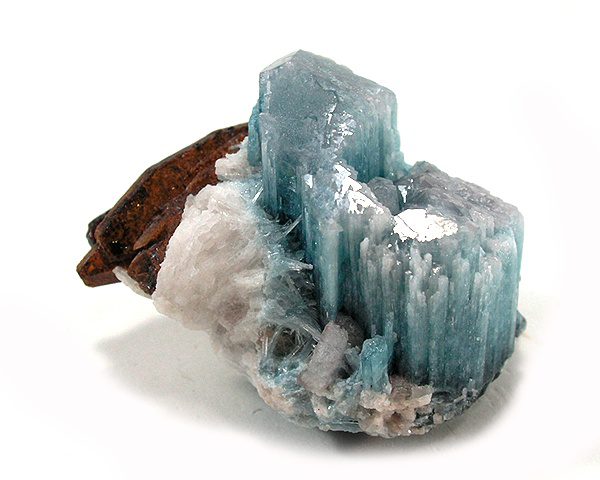
Blue indicolite tourmaline with stibiotantalite and albite from the Darra-i-Pech pegmatite field.
Photo: Robert M. Lavinsky · CC BY-SA 3.0 · Source

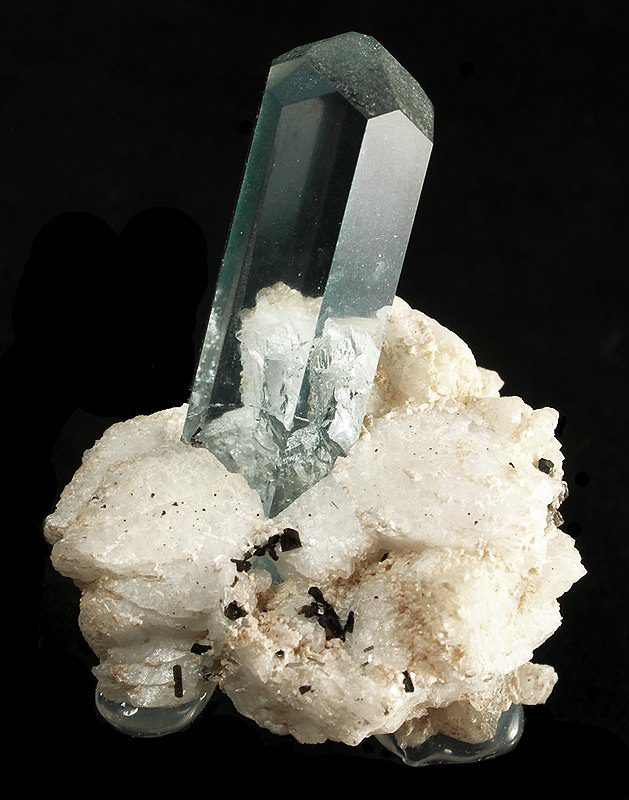
Pale blue gem aquamarine on white crystallized albite from the Shigar Valley.
Photo: Robert M. Lavinsky · CC BY-SA 3.0 · Source

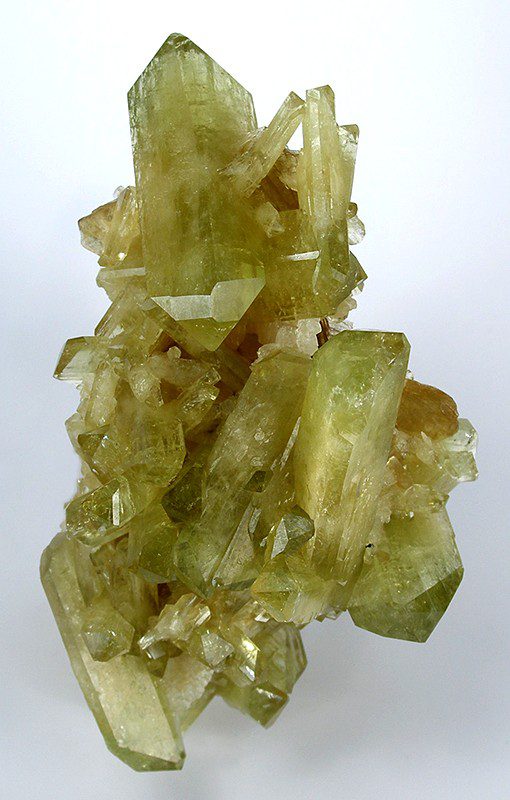
Doubly terminated yellow-green brazilianite crystals on albite, Telírio claim, Linópolis.
Photo: Robert M. Lavinsky · CC BY-SA 3.0 · Source

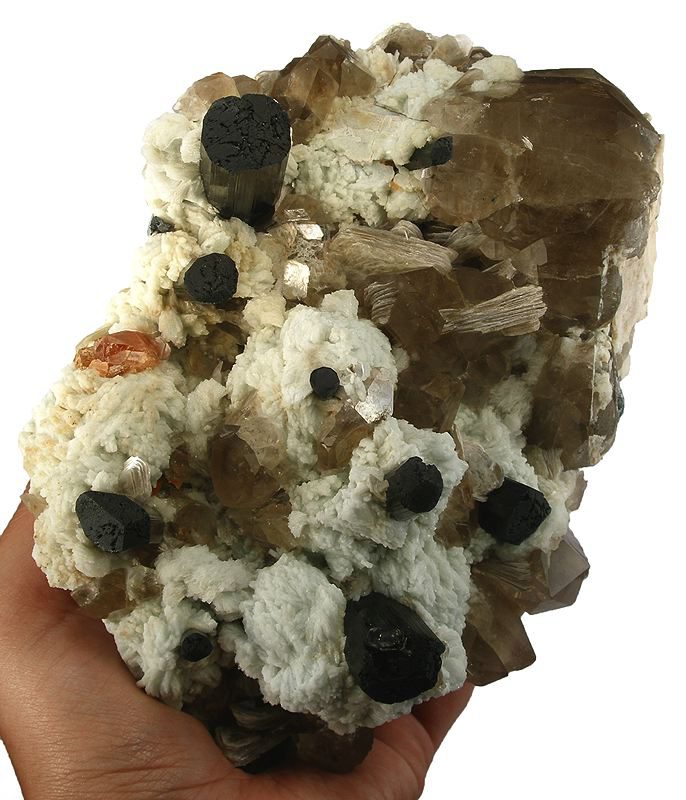
Large schorl group with a spessartine crystal on white albite and quartz matrix from the Little Three Mine.
Photo: Robert M. Lavinsky · CC BY-SA 3.0 · Source

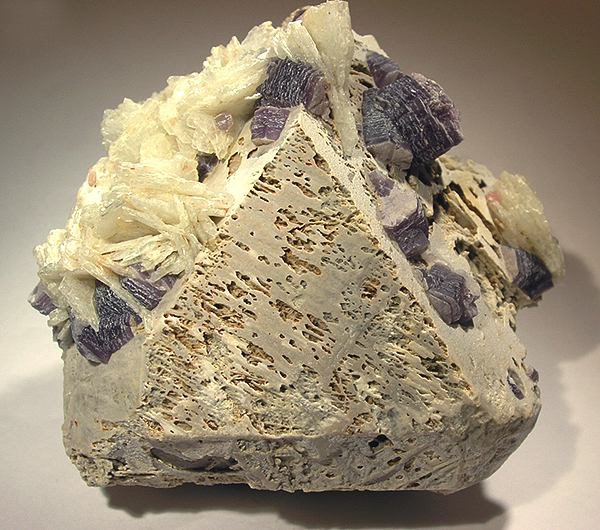
Twinned microcline with white cleavelandite albite and purple lepidolite, Himalaya Mine.
Photo: Robert M. Lavinsky · CC BY-SA 3.0 · Source

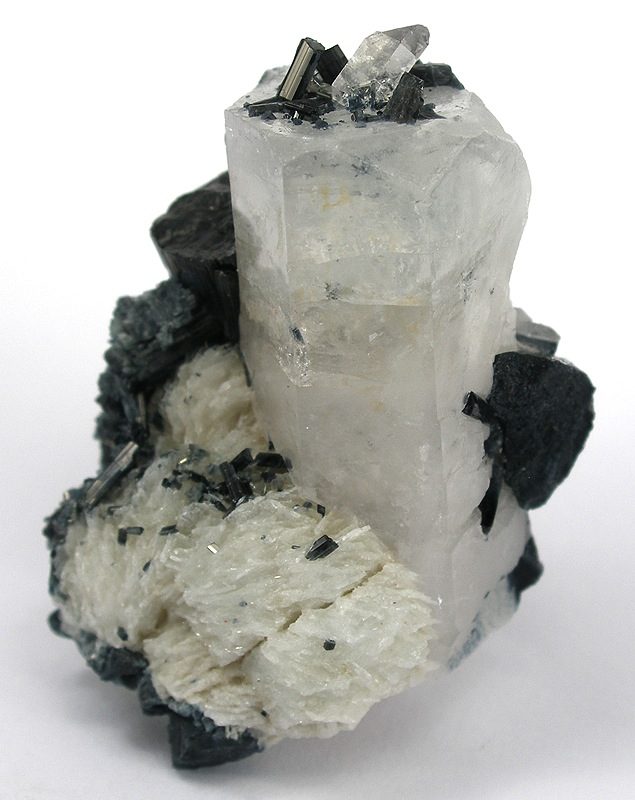
Goshenite with schorl on albite from the Cryo-Genie Mine.
Photo: Robert M. Lavinsky · CC BY-SA 3.0 · Source

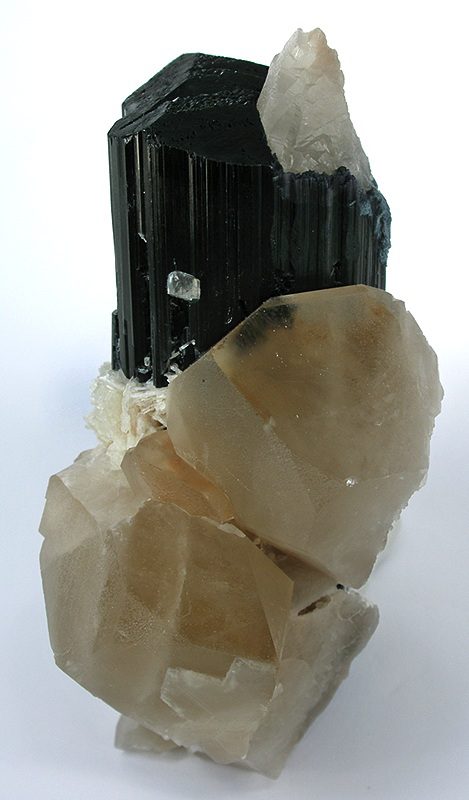
Thick schorl crystals with gemmy quartz and white albite blades, Pala Chief Mine.
Photo: Robert M. Lavinsky · CC BY-SA 3.0 · Source

Where Albite is found (21)
Afghanistan
- Darra-i-Pech pegmatite fieldNangarhar · 5 photos
Brazil
- Barra de SalinasMinas Gerais · 2 photos
- GalileiaMinas Gerais · 3 photos
- LinópolisMinas Gerais · 5 photos
- MarilacMinas Gerais · 3 photos
- São José da SafiraMinas Gerais · 3 photos
Canada
- Mont Saint-HilaireQuebec · 2 photos
Pakistan
- Dassu (Dusso)Skardu District · 5 photos
- Shengus (Shingus)Northern Areas (Baltistan) · 2 photos
- Shigar ValleySkardu District · 5 photos
- Stak NalaSkardu District · 3 photos
United States
- Bennett QuarryMaine · 3 photos
- Cryo-Genie Mine (Lost Valley Truck Trail Mine)California · 3 photos
- Himalaya MineCalifornia · 4 photos
- Little Three MineCalifornia · 5 photos
- Lookout Mine (Hercules group)California · 1 photo
- Magnet CoveArkansas · 1 photo
- Pack Rat MineCalifornia · 3 photos
- Pala Chief MineCalifornia · 3 photos
- Vanderburg Mine (Sickler)California · 2 photos
- White Queen MineCalifornia · 3 photos
Albite on the same specimen with other minerals
1 specimen photo(s) from this locality show quartz with albite together. The pairing comes from the photographer's file name and label, so the relationship between the two minerals is not specified.
2 specimen photo(s) from this locality show quartz with albite together. The pairing comes from the photographer's file name and label, so the relationship between the two minerals is not specified.
1 specimen photo(s) from this locality show quartz with albite together. The pairing comes from the photographer's file name and label, so the relationship between the two minerals is not specified.
1 specimen photo(s) from this locality show quartz with albite together. The pairing comes from the photographer's file name and label, so the relationship between the two minerals is not specified.
1 specimen photo(s) from this locality show microcline with albite together. The pairing comes from the photographer's file name and label, so the relationship between the two minerals is not specified.
2 specimen photo(s) from this locality show microcline with albite together. The pairing comes from the photographer's file name and label, so the relationship between the two minerals is not specified.
1 specimen photo(s) from this locality show microcline with albite together. The pairing comes from the photographer's file name and label, so the relationship between the two minerals is not specified.
1 specimen photo(s) from this locality show beryl with albite together. The pairing comes from the photographer's file name and label, so the relationship between the two minerals is not specified.
Identity
- Also called
- Cleavelandite (bladed variety); low albite; high albite
- Group
- Feldspar Group
- Strunz
- 9.FA.35 · 9 Silicates
- IMA status
- Grandfathered
- Name origin
- From Latin albus (white), after its usual colour.
- Elements
- Na, Al, Si, O
Physical properties
- Color
- White to grey, bluish, greenish or reddish; may be chatoyant
- Streak
- White
- Luster
- Vitreous luster
- Transparency
- Variable
- Mohs hardness
- 6–6.5
- Density
- 2.6–2.65 g/cm³
- Cleavage / fracture
- Perfect cleavage on {001}, very good on {010}, imperfect on {110}; fracture uneven to conchoidal; brittle
- Magnetism / fluorescence
- Some specimens fluoresce: white in longwave UV and red to bluish in shortwave UV
Crystallography
- Crystal system
- Triclinic
- Space group
- C-1
- Structure
- Feldspar framework of linked SiO4 and AlO4 tetrahedra with Na in the cavities; an ordered low-temperature form (low albite) and a disordered high-temperature form (high albite) are recognised.
- Typical habit
- Tabular crystals flattened on {010}, sometimes curved, usually to about 3 cm; divergent and bladed aggregates (cleavelandite), granular or cleavable masses
- Twinning
- Very common polysynthetic twinning on the albite law ({010}), giving fine striations on {001} or {010}; many other laws, simple and multiple
- Optical data
- Biaxial (+) for low albite, (-) for high albite; nα = 1.526-1.530, nβ = 1.531-1.533, nγ = 1.534-1.541; 2V about 85-90° (low) or 52-54° (high); weak dispersion r < v
Formation and use
- Formation
- Major constituent of granites and granite pegmatites, alkalic diorites and basalts; also in hydrothermal and alpine veins, low-grade metamorphic rocks and schists, and as detrital or authigenic grains in sedimentary rocks.
Related minerals
- Related minerals
- Microclineorthoclase
Sources
- SRC-523 · Book
Handbook of Mineralogy - AlbiteAnthony, J.W.; Bideaux, R.A.; Bladh, K.W.; Nichols, M.C. · 2001 · Mineral Data Publishing / Mineralogical Society of America - SRC-524 · Database
Albite Mineral DataBarthelmy, D. · Webmineral.com - SRC-538 · Website
File:Albite-Quartz-Spessartine-ck3a.jpgRobert M. Lavinsky · Wikimedia Commons

Draft data from the Provenite workbook. Check entries against the cited sources before relying on them. Photos are open-licence images from Wikimedia Commons; the author and licence are given with each photo.