About Morganite
Be3Al2Si6O18
Morganite is the pink to orange-pink variety of beryl, coloured by trace manganese. Colour ranges from pink and purplish pink to orangy pink; untreated stones often show an orange component that gives a salmon colour, while strong pink is rare and mostly seen in larger stones. It is strongly pleochroic, so rough is oriented carefully before cutting. Brazilian crystals can exceed 10 kg.
Photos of Morganite
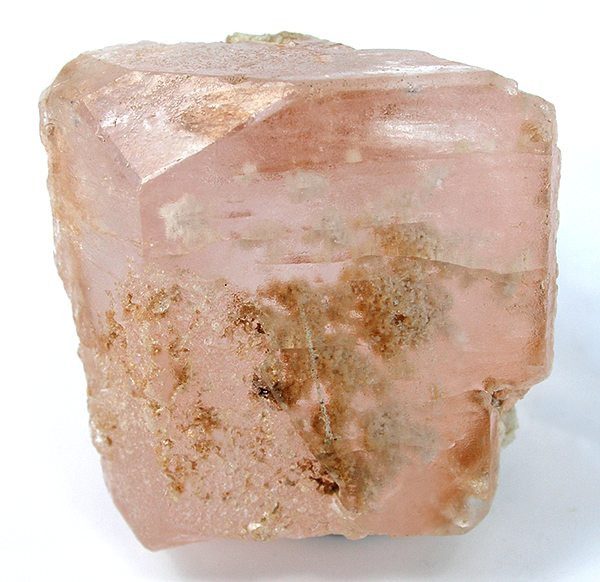
Euhedral gemmy pink morganite crystal of about 4.4 cm from the White Queen Mine, Pala.
Photo: Robert M. Lavinsky · CC BY-SA 3.0 · Source

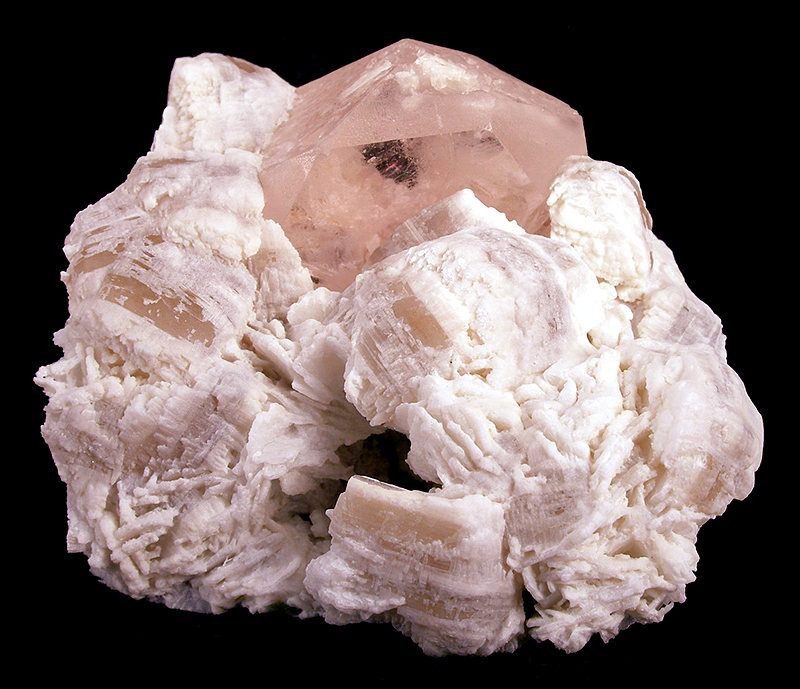
Sharp hexagonal pink morganite crystal of 4 cm on crystallized mica-quartz matrix, Darra-i-Pech.
Photo: Robert M. Lavinsky · CC BY-SA 3.0 · Source

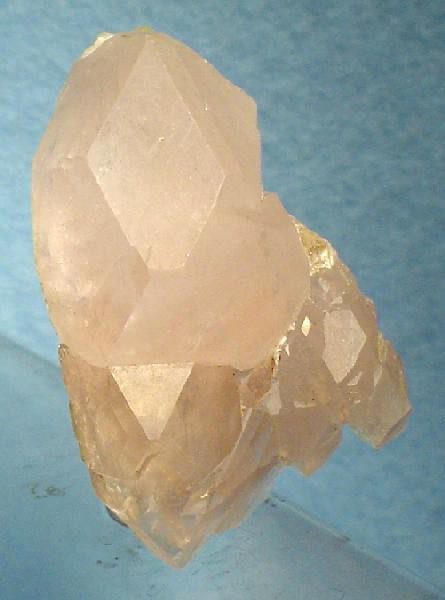
Cluster of sharp, gemmy pastel-pink morganite crystals from the Stewart Mine, Pala, ex John Barlow collection.
Photo: Robert M. Lavinsky · CC BY-SA 3.0 · Source

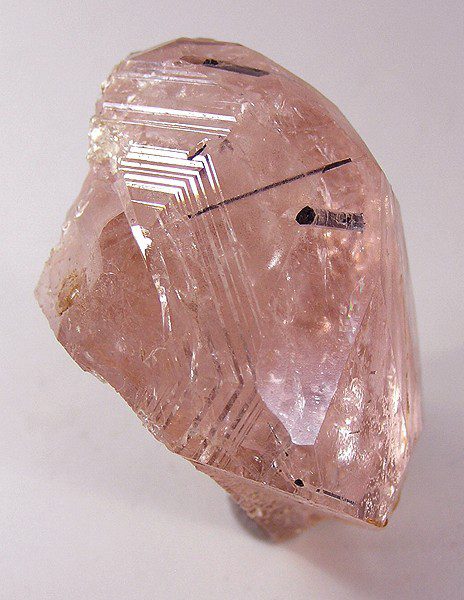
Large pink gem morganite crystal from a 1960s find at the Urucum mine, Galileia.
Photo: Robert M. Lavinsky · CC BY-SA 3.0 · Source

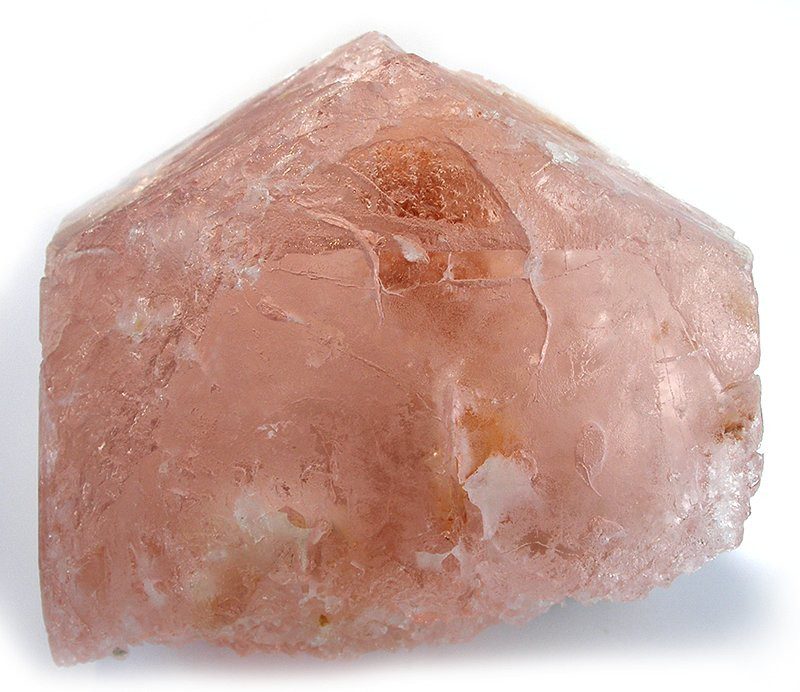
Large hexagonal rich pink morganite crystal with mildly etched faces from the Tourmaline Queen Mine, Pala.
Photo: Robert M. Lavinsky · CC BY-SA 3.0 · Source

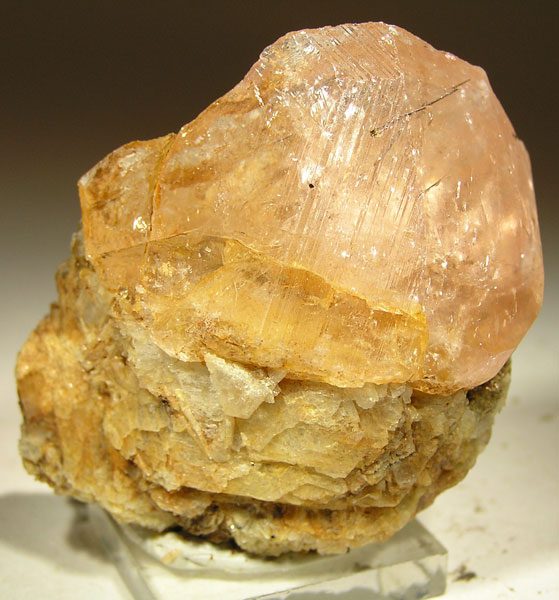
Gemmy pink morganite crystal of 5 cm from the Alto Ligonha district, Mozambique.
Photo: Robert M. Lavinsky · CC BY-SA 3.0 · Source

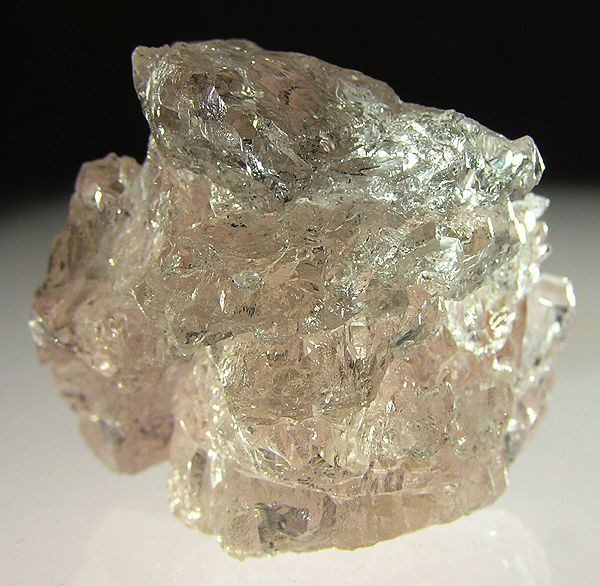
Naturally etched morganite crystal of about 4 cm with an irregular form from Virgem da Lapa, Minas Gerais.
Photo: Robert M. Lavinsky · CC BY-SA 3.0 · Source

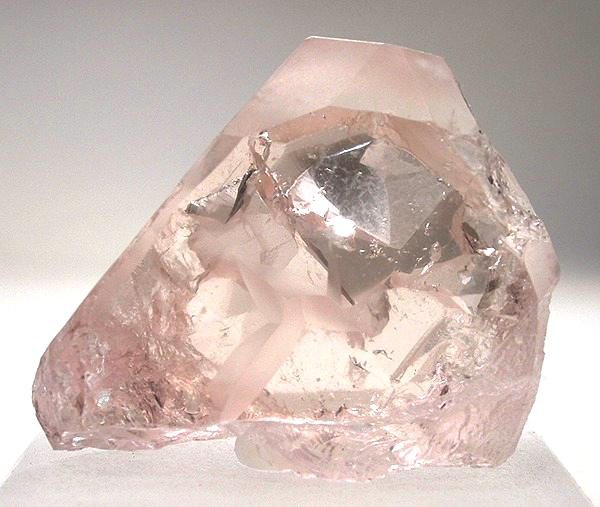
Complete pink morganite crystal of 53 g from the Little Three Mine, Ramona.
Photo: Robert M. Lavinsky · CC BY-SA 3.0 · Source

Where Morganite is found (12)
Afghanistan
- Darra-i-Pech pegmatite fieldNangarhar · 5 photos
Brazil
- AraçuaíMinas Gerais · 1 photo
- Conselheiro PenaMinas Gerais · 1 photo
- GalileiaMinas Gerais · 3 photos
- São José da SafiraMinas Gerais · 1 photo
- Virgem da LapaMinas Gerais · 1 photo
Mozambique
- Alto Ligonha pegmatitesZambezia Province · 1 photo
United States
- Little Three MineCalifornia · 1 photo
- Stewart Mine (Stewart Lithia Mine)California · 3 photos
- Tourmaline Queen MineCalifornia · 2 photos
- Vanderburg Mine (Sickler)California · 1 photo
- White Queen MineCalifornia · 5 photos
Identity
- Variety of
- Beryl
- Also called
- Pink beryl
- Strunz
- 9 Silicates
- IMA status
- Variety
- Name origin
- Named after the American financier J. P. Morgan, a gem collector; introduced to the market by Tiffany & Co. after its discovery in Madagascar in 1910
- Elements
- Be, Al, Si, O
Physical properties
- Color
- Pale pink, purplish pink, peach to orangy pink (salmon); never dark in tone
- Streak
- White
- Luster
- Vitreous luster
- Transparency
- Variable
- Mohs hardness
- 7.5–8
- Density
- 2.63–2.97 g/cm³
- Cleavage / fracture
- Imperfect cleavage on {0001}; conchoidal to uneven fracture; brittle
Crystallography
- Crystal system
- Hexagonal
- Space group
- P6/mcc
- Typical habit
- Prismatic to tabular hexagonal crystals, often short and tabular with pyramid modifications (beryl habits)
- Twinning
- Rare
- Optical data
- Uniaxial (-); nω = 1.567-1.610, nε = 1.565-1.599 for beryl, rising with alkali content; strongly pleochroic in pale pink and deeper bluish pink
Formation and use
- Formation
- Beryl forms in granites and granite pegmatites, with quartz, feldspar, muscovite, lepidolite, spodumene, amblygonite and tourmaline; morganite comes from pegmatites and from alluvial deposits derived from them.
- Uses
- Gemstone; mineral specimens
- Stability and care
- Heat and light remove the yellow component of peach beryl, so morganite is commonly heated to obtain a pinker colour; irradiation is occasionally used but the resulting colour fades in light. Hardness 7.5-8 and wearability are good; warm water, mild detergent and a soft brush are safe, while mechanical cleaning should only be used on stones free of fractures.
Related minerals
- Related minerals
- BerylEmeraldAquamarine
Sources
- SRC-266 · Book
Handbook of Mineralogy - BerylAnthony, J.W.; Bideaux, R.A.; Bladh, K.W.; Nichols, M.C. · 2001 · Mineralogical Society of America / Mineral Data Publishing - SRC-840 · Website
What Is Morganite Gemstone | Morganite Stone - GIAGemological Institute of America · GIA Gem Encyclopedia - SRC-841 · Website
Morganite Value, Price, and Jewelry InformationArem, J.E.; Clark, D.; Smigel, B. · 2025 · International Gem Society
Draft data from the Provenite workbook. Check entries against the cited sources before relying on them. Photos are open-licence images from Wikimedia Commons; the author and licence are given with each photo.