About Fluorite
CaF₂
Calcium fluoride that defines hardness 4 on the Mohs scale and is prized for its wide colour range, bright cubic crystals and strong zoning; fluorescence was named after it.
Photos of Fluorite
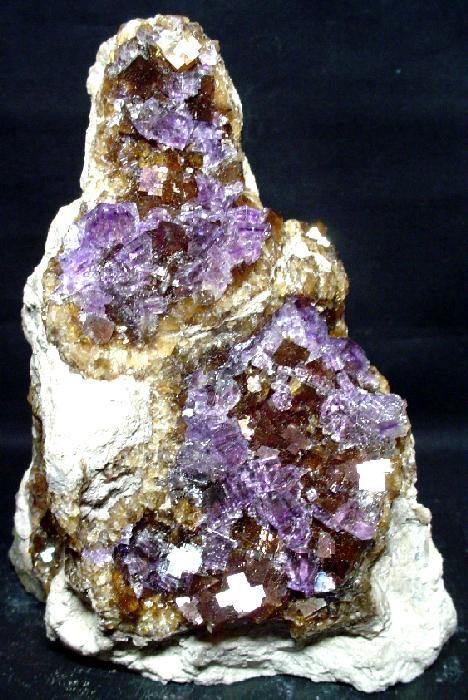
Cabinet specimen with calcite-lined vugs holding zoned purple fluorite cubes, Stoneco Auglaize quarry.
Photo: Robert M. Lavinsky · CC BY-SA 3.0 · Source

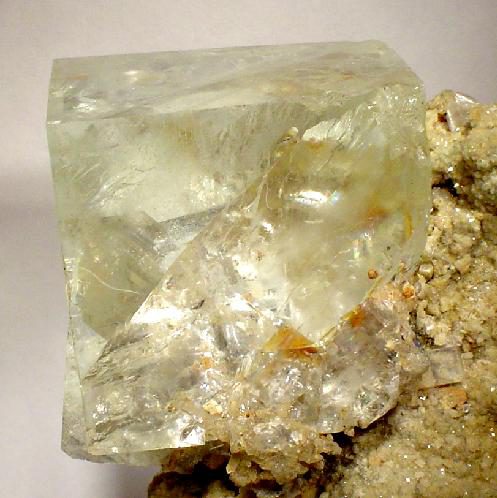
Light-green glassy fluorite cube on matrix from the Nikolaevskiy mine, Dalnegorsk.
Photo: Robert M. Lavinsky · CC BY-SA 3.0 · Source

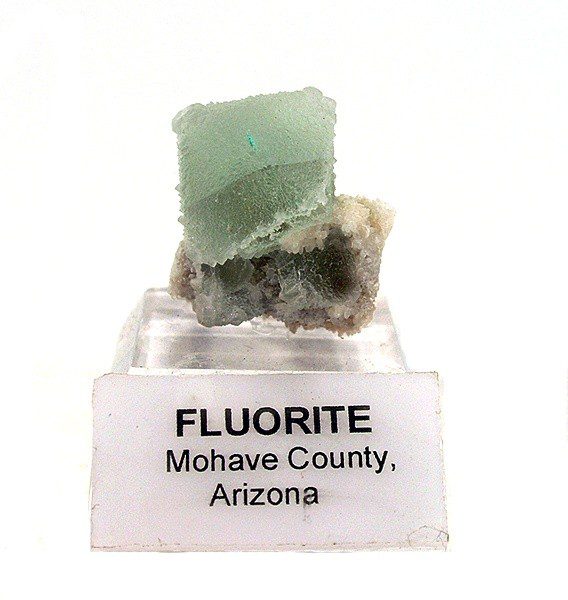
Small fluorite specimen from the Oatman district, Arizona.
Photo: Robert M. Lavinsky · CC BY-SA 3.0 · Source

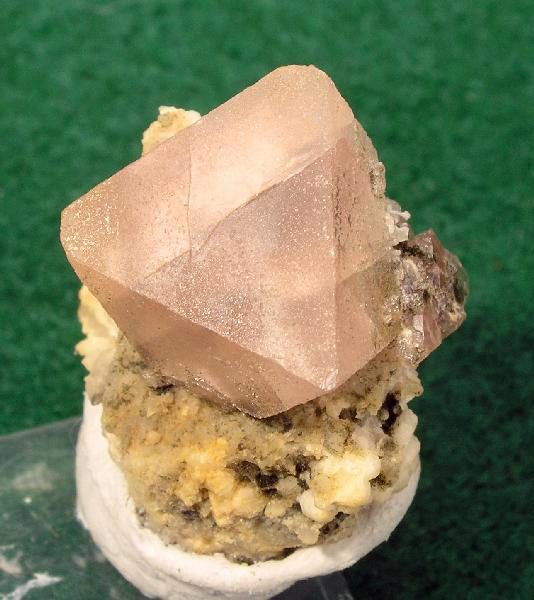
Pale pink fluorite crystals on adularia matrix from the Argentière Glacier.
Photo: Robert M. Lavinsky · CC BY-SA 3.0 · Source

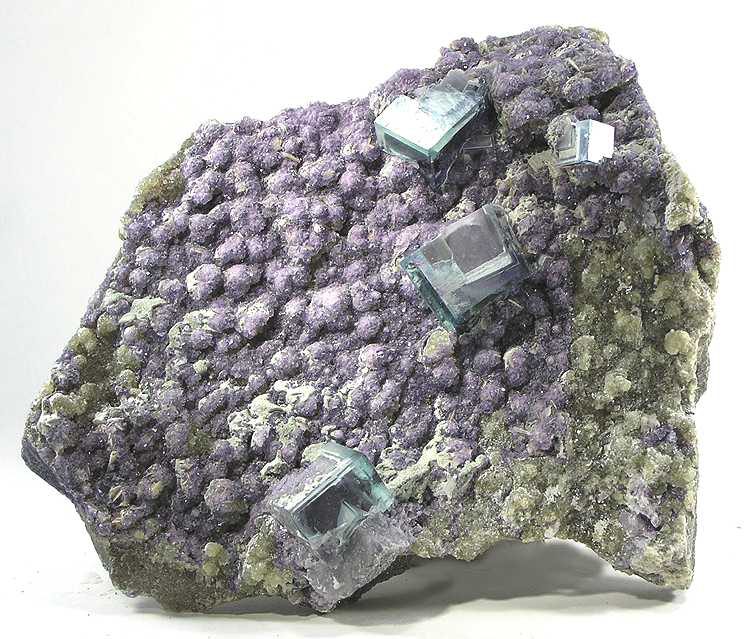
Fluorite cubes with teal-blue phantom zoning on a purple microcrystal plate, Yaogangxian.
Photo: Robert M. Lavinsky · CC BY-SA 3.0 · Source

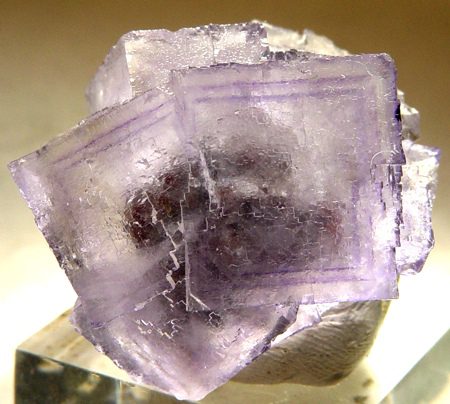
Light, clear intergrown fluorite crystals with phantom lines from the Elmwood mine.
Photo: Robert M. Lavinsky · CC BY-SA 3.0 · Source

Where Fluorite is found (6)
China
- Yaogangxian MineHunan · 1 photo
France
- Argentière Glacier area (Mont Blanc massif, Chamonix)Haute-Savoie · 1 photo
Russia
- DalnegorskPrimorsky Krai · 1 photo
United States
- Elmwood Mine (Carthage, Smith County)Tennessee · 1 photo
- Oatman Mining District (Moss Mine area)Arizona · 1 photo
- Stoneco Auglaize Quarry (Junction, Paulding County)Ohio · 1 photo
Fluorite on the same specimen with other minerals
1 specimen photo(s) from this locality show chalcopyrite with fluorite together. The pairing comes from the photographer's file name and label, so the relationship between the two minerals is not specified.
1 specimen photo(s) from this locality show galena with fluorite together. The pairing comes from the photographer's file name and label, so the relationship between the two minerals is not specified.
1 specimen photo(s) from this locality show dolomite with fluorite together. The pairing comes from the photographer's file name and label, so the relationship between the two minerals is not specified.
1 specimen photo(s) from this locality show microcline with fluorite together. The pairing comes from the photographer's file name and label, so the relationship between the two minerals is not specified.
1 specimen photo(s) from this locality show microcline with fluorite together. The pairing comes from the photographer's file name and label, so the relationship between the two minerals is not specified.
1 specimen photo(s) from this locality show beryl with fluorite together. The pairing comes from the photographer's file name and label, so the relationship between the two minerals is not specified.
1 specimen photo(s) from this locality show fluorite with beryl together. The pairing comes from the photographer's file name and label, so the relationship between the two minerals is not specified.
1 specimen photo(s) from this locality show rhodochrosite with fluorite together. The pairing comes from the photographer's file name and label, so the relationship between the two minerals is not specified.
Identity
- Also called
- fluorspar
- Strunz
- 3.AB.25 · 3 Halides
- IMA status
- Grandfathered
- Name origin
- From Latin 'fluere' (to flow), because the mineral was used as a flux in smelting; the older term 'fluorspar' goes back to Agricola's sixteenth-century writings.
- Elements
- Ca, F
Physical properties
- Color
- Highly variable: colorless, white, yellow, green, blue, red and purple to violet; often color-zoned
- Streak
- White
- Luster
- Vitreous luster
- Transparency
- Variable
- Mohs hardness
- 4
- Density
- 3.01–3.25 g/cm³
- Cleavage / fracture
- Perfect octahedral cleavage on {111}, with parting on {011}; fracture subconchoidal to uneven
- Magnetism / fluorescence
- Commonly fluorescent under UV light (often blue to violet, depending on impurities); thermoluminescent; UV response is not a reliable identification test
Crystallography
- Crystal system
- Cubic
- Space group
- Fm-3m
- Typical habit
- Cubes, often with octahedral and more complex forms; also nodular, botryoidal, granular and massive
- Twinning
- Common on {111}, often as interpenetrant twins
- Optical data
- Isotropic; refractive index about 1.433 to 1.448
Formation and use
- Formation
- Forms late in felsic igneous systems, mainly from hydrothermal fluids and in granitic pegmatites; fills veins in limestone together with galena, sphalerite, barite, quartz and calcite; also occurs as grains or cement in sedimentary rocks.
- Uses
- Metallurgical flux, ceramic and glass manufacture, source of hydrogen fluoride and hydrofluoric acid, optical components, and ornamental or lapidary material; widely collected as crystal specimens.
Sources
- SRC-182 · Database
Fluorite Mineral Data (Webmineral)Barthelmy, D. · Webmineral - SRC-183 · Website
FluoriteWikipedia contributors · Wikipedia
Draft data from the Provenite workbook. Check entries against the cited sources before relying on them. Photos are open-licence images from Wikimedia Commons; the author and licence are given with each photo.