About Chalcopyrite
CuFeS₂
A brass-yellow copper-iron sulfide that is the most important ore of copper; it is softer than pyrite and more brittle than gold, and it tarnishes to iridescent blues, purples and greens.
Photos of Chalcopyrite
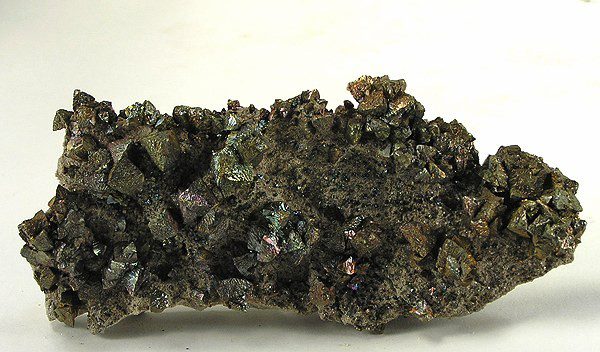
Chalcopyrite crystals up to about 1 cm on matrix from the Sweetwater Mine.
Photo: Robert M. Lavinsky · CC BY-SA 3.0 · Source

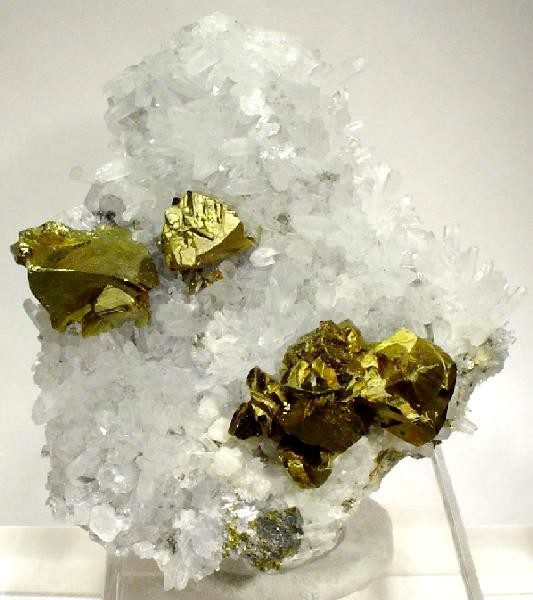
Mirror-bright, brass-yellow twinned chalcopyrite crystals with quartz and dolomite.
Photo: Robert M. Lavinsky · CC BY-SA 3.0 · Source

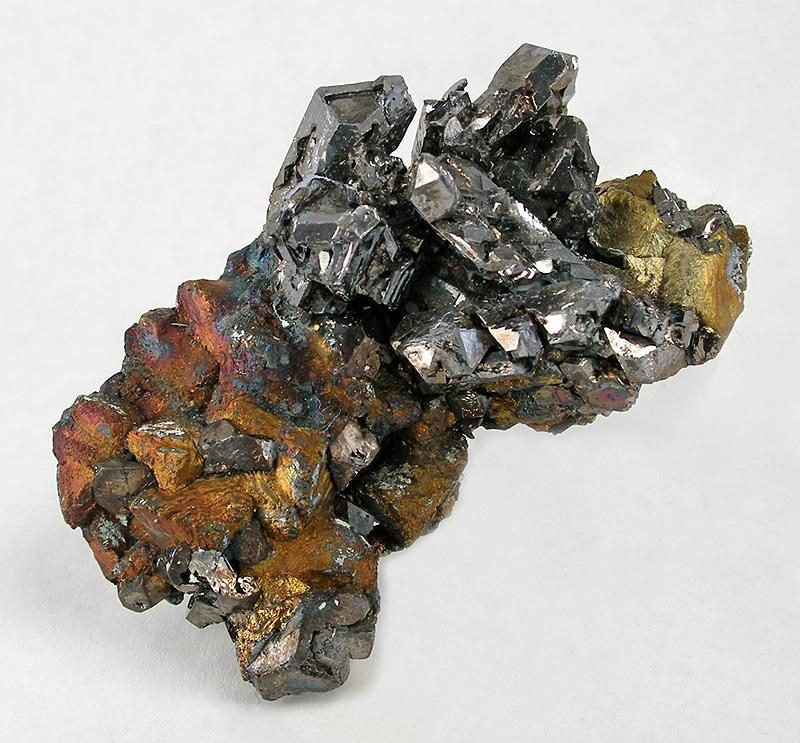
Elongated hoppered galena crystals on bronze, iridescent chalcopyrite.
Photo: Robert M. Lavinsky · CC BY-SA 3.0 · Source

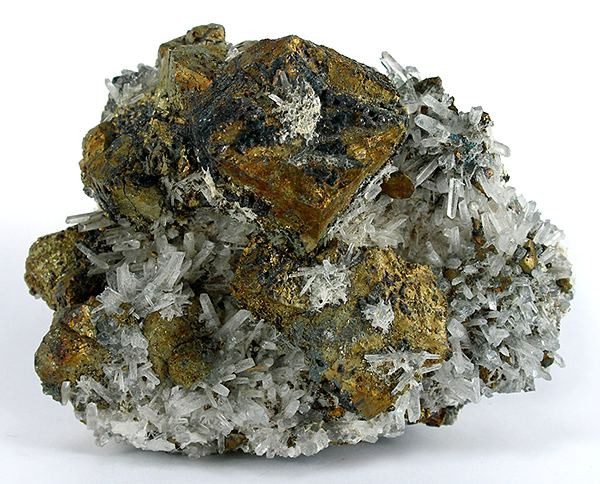
Chalcopyrite crystals up to 2.5 cm set in a nest of quartz points.
Photo: Robert M. Lavinsky · CC BY-SA 3.0 · Source

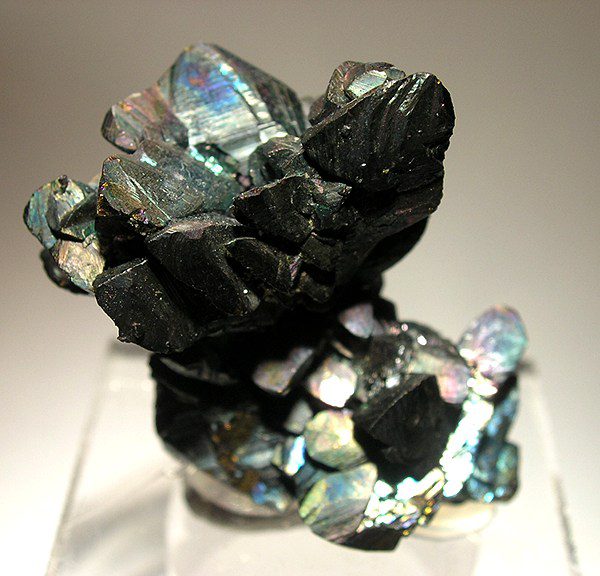
Sharp chalcopyrite crystals with strong iridescent tarnish from the Yaogangxian Mine.
Photo: Robert M. Lavinsky · CC BY-SA 3.0 · Source

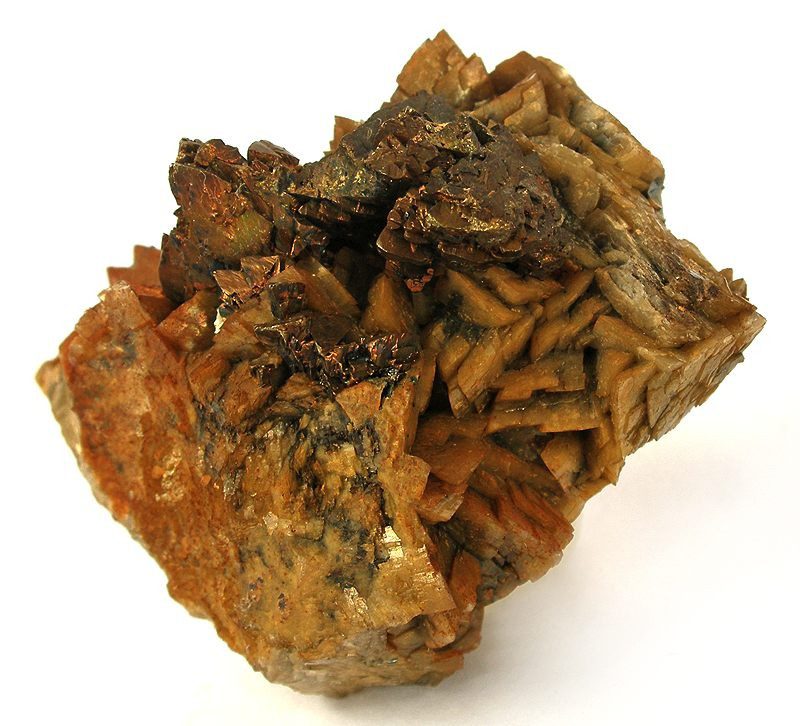
Sharp chalcopyrite crystals over 1 cm on crystallized siderite.
Photo: Robert M. Lavinsky · CC BY-SA 3.0 · Source

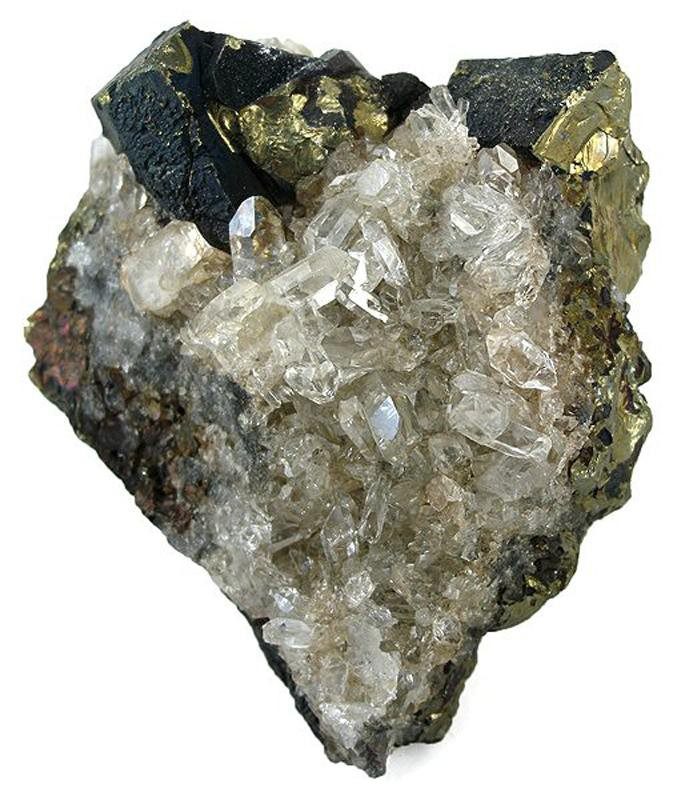
Chalcopyrite crystals up to 2 cm across on a quartz matrix.
Photo: Robert M. Lavinsky · CC BY-SA 3.0 · Source

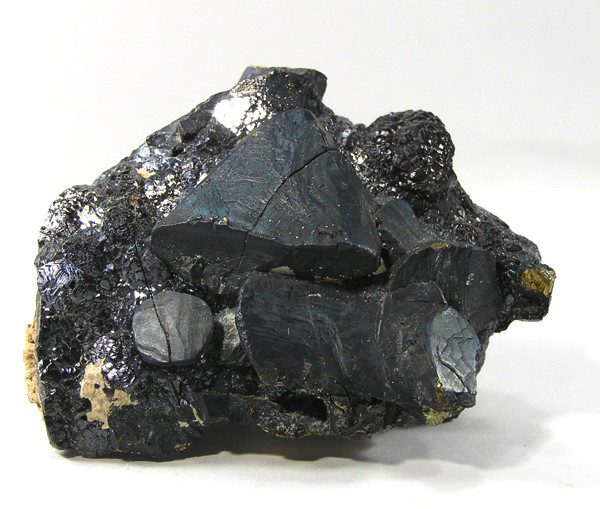
Gunmetal-grey chalcopyrite crystals up to 2 cm embedded in sphalerite.
Photo: Robert M. Lavinsky · CC BY-SA 3.0 · Source

Where Chalcopyrite is found (13)
Canada
- Kidd Creek MineOntario
China
- Yaogangxian MineHunan · 3 photos
Germany
- Neudorf (Harzgerode)Saxony-Anhalt · 2 photos
Namibia
- Tsumeb MineOshikoto Region
Peru
- Animón Mine (Huarón mining district)Pasco · 3 photos
- HuanzalaAncash
- Huarón Mine (Huarón Mining District)Pasco · 3 photos
Romania
- CavnicMaramures County · 3 photos
Russia
- DalnegorskPrimorsky Krai · 1 photo
Spain
United States
- Butte Mining DistrictMontana
- Ellenville Mine (Ellenville Lead Mine; Ulster mine)New York · 2 photos
- Viburnum TrendMissouri · 3 photos
Chalcopyrite on the same specimen with other minerals
Gunmetal-grey galena cubes sit on a chalcopyrite matrix in specimens from the Buick Mine in the Viburnum Trend.
A bright metallic lead sulfide on a brassy copper sulfide gives a strong colour and luster contrast in a Mississippi Valley-type specimen.
Sources: SRC-047
On the same type of Cavnic plate, iridescent brassy chalcopyrite crystals occur on the matrix together with the pyrite, and the amethyst clusters rise from this sulfide-covered matrix.
The iridescent chalcopyrite adds a second metallic colour beneath the purple quartz.
A Yaogangxian specimen has a floret of sharp golden chalcopyrite sphenoids, about 3 cm, set on a tabular doubly terminated quartz crystal; contacts are healed and overgrown by quartz faces.
Iridescent chalcopyrite on a glassy, doubly terminated quartz is a rare and aesthetic floater-type piece.
Sources: SRC-162
1 specimen photo(s) from this locality show marcasite with chalcopyrite together. The pairing comes from the photographer's file name and label, so the relationship between the two minerals is not specified.
1 specimen photo(s) from this locality show chalcopyrite with fluorite together. The pairing comes from the photographer's file name and label, so the relationship between the two minerals is not specified.
1 specimen photo(s) from this locality show chalcopyrite with quartz together. The pairing comes from the photographer's file name and label, so the relationship between the two minerals is not specified.
2 specimen photo(s) from this locality show chalcopyrite with sphalerite together. The pairing comes from the photographer's file name and label, so the relationship between the two minerals is not specified.
1 specimen photo(s) from this locality show chalcopyrite with calcite together. The pairing comes from the photographer's file name and label, so the relationship between the two minerals is not specified.
1 specimen photo(s) from this locality show chalcopyrite with galena together. The pairing comes from the photographer's file name and label, so the relationship between the two minerals is not specified.
2 specimen photo(s) from this locality show chalcopyrite with quartz together. The pairing comes from the photographer's file name and label, so the relationship between the two minerals is not specified.
2 specimen photo(s) from this locality show chalcopyrite with quartz together. The pairing comes from the photographer's file name and label, so the relationship between the two minerals is not specified.
2 specimen photo(s) from this locality show chalcopyrite with sphalerite together. The pairing comes from the photographer's file name and label, so the relationship between the two minerals is not specified.
2 specimen photo(s) from this locality show chalcopyrite with quartz together. The pairing comes from the photographer's file name and label, so the relationship between the two minerals is not specified.
3 specimen photo(s) from this locality show sphalerite with chalcopyrite together. The pairing comes from the photographer's file name and label, so the relationship between the two minerals is not specified.
1 specimen photo(s) from this locality show sphalerite with chalcopyrite together. The pairing comes from the photographer's file name and label, so the relationship between the two minerals is not specified.
1 specimen photo(s) from this locality show sphalerite with chalcopyrite together. The pairing comes from the photographer's file name and label, so the relationship between the two minerals is not specified.
1 specimen photo(s) from this locality show sphalerite with chalcopyrite together. The pairing comes from the photographer's file name and label, so the relationship between the two minerals is not specified.
1 specimen photo(s) from this locality show pyrite with chalcopyrite together. The pairing comes from the photographer's file name and label, so the relationship between the two minerals is not specified.
1 specimen photo(s) from this locality show chalcopyrite with dolomite together. The pairing comes from the photographer's file name and label, so the relationship between the two minerals is not specified.
1 specimen photo(s) from this locality show chalcopyrite with siderite together. The pairing comes from the photographer's file name and label, so the relationship between the two minerals is not specified.
1 specimen photo(s) from this locality show dolomite with chalcopyrite together. The pairing comes from the photographer's file name and label, so the relationship between the two minerals is not specified.
1 specimen photo(s) from this locality show bornite with chalcopyrite together. The pairing comes from the photographer's file name and label, so the relationship between the two minerals is not specified.
1 specimen photo(s) from this locality show bornite with chalcopyrite together. The pairing comes from the photographer's file name and label, so the relationship between the two minerals is not specified.
1 specimen photo(s) from this locality show rhodochrosite with chalcopyrite together. The pairing comes from the photographer's file name and label, so the relationship between the two minerals is not specified.
1 specimen photo(s) from this locality show rhodochrosite with chalcopyrite together. The pairing comes from the photographer's file name and label, so the relationship between the two minerals is not specified.
Identity
- Also called
- yellow copper
- Group
- Chalcopyrite Group
- Strunz
- 2.CB.10a · 2 Sulfides and sulfosalts
- IMA status
- Grandfathered
- Name origin
- From Greek 'chalkos' (copper) and 'pyrites' (stone that strikes fire); named by Johann Friedrich Henckel in 1725.
- Elements
- Cu, Fe, S
Physical properties
- Color
- Brass-yellow; commonly tarnished with an iridescent film
- Streak
- Greenish black
- Luster
- Metallic luster
- Transparency
- Opaque
- Mohs hardness
- 3.5–4
- Density
- 4.1–4.3 g/cm³
- Cleavage / fracture
- Cleavage poor on {011} and {111}; fracture conchoidal; brittle
- Magnetism / fluorescence
- Reported to become magnetic on heating
Crystallography
- Crystal system
- Tetragonal
- Space group
- I-42d
- Structure
- Tetragonal cell with a = 5.281 Å, c = 10.401 Å and Z = 4 (point group -42m); shares its tetragonal structure type with other members of the chalcopyrite group such as gallite, laforêtite, lenaite, roquesite and shenzhuangite.
- Typical habit
- Equant, pseudo-tetrahedral (disphenoidal) crystals, sometimes modified by scalenohedral faces; far more often massive, compact or disseminated; occasionally botryoidal
- Twinning
- Twin planes {112} and {012}; rotation twins about [001] with a {110} composition plane give penetration twins
- Optical data
- Opaque; weakly anisotropic in reflected light; reflectance rises from roughly 16-17% at 400 nm to roughly 47-49% at 600-700 nm
Formation and use
- Formation
- Hydrothermal veins, stockworks, disseminations and massive replacements; porphyry copper systems; volcanogenic massive sulfide and sedimentary exhalative deposits; exsolution product in mafic igneous rocks and accessory in magmatic nickel sulfide deposits; also in sedimentary settings controlled by redox conditions.
- Uses
- Principal ore of copper, smelted (pyrometallurgy) or leached (hydrometallurgy) to produce the metal; collector's specimen.
- Stability and care
- Tarnishes in air to oxides, hydroxides and sulfates, producing an iridescent surface; weathering in nature gives secondary copper minerals such as malachite, azurite and brochantite.
Related minerals
- Related minerals
- Eskebornite (forms a series with chalcopyrite)gallitelaforêtitelenaiteroquesiteshenzhuangite (chalcopyrite group)
- Can be confused with
- Pyritegold
Sources
- SRC-030 · Book
Handbook of Mineralogy - ChalcopyriteAnthony, J.W.; Bideaux, R.A.; Bladh, K.W.; Nichols, M.C. · Mineralogical Society of America - SRC-031 · Database
Chalcopyrite: Mineral information, data and localities (Mindat.org)Mindat.org / Hudson Institute of Mineralogy - SRC-032 · Website
Chalcopyrite (Wikipedia)Wikipedia - SRC-033 · Website
The mineral chalcopyrite (Amethyst Galleries)Amethyst Galleries
Draft data from the Provenite workbook. Check entries against the cited sources before relying on them. Photos are open-licence images from Wikimedia Commons; the author and licence are given with each photo.