About Galena
PbS
Heavy, lead-gray lead sulfide that typically forms bright metallic cubes and breaks into smaller cubes along its perfect cleavage; it is the most important ore mineral of lead.
Photos of Galena
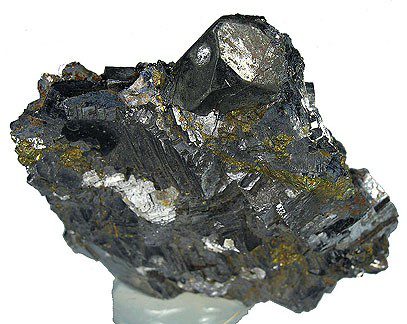
Silvery-gray galena cuboctahedron on a small Tsumeb specimen.
Photo: Robert M. Lavinsky · CC BY-SA 3.0 · Source

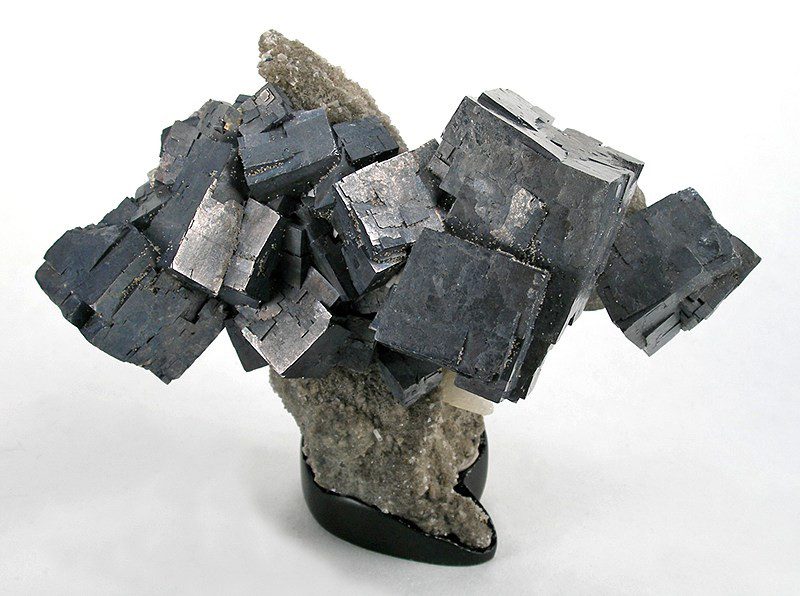
Cluster of galena crystals from the Sweetwater Mine displayed on matrix.
Photo: Robert M. Lavinsky · CC BY-SA 3.0 · Source

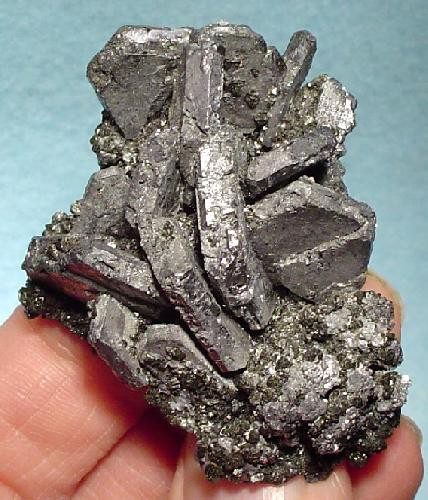
Cluster of sharp lead-gray spinel-twinned galena crystals to 2 cm across.
Photo: Robert M. Lavinsky · CC BY-SA 3.0 · Source

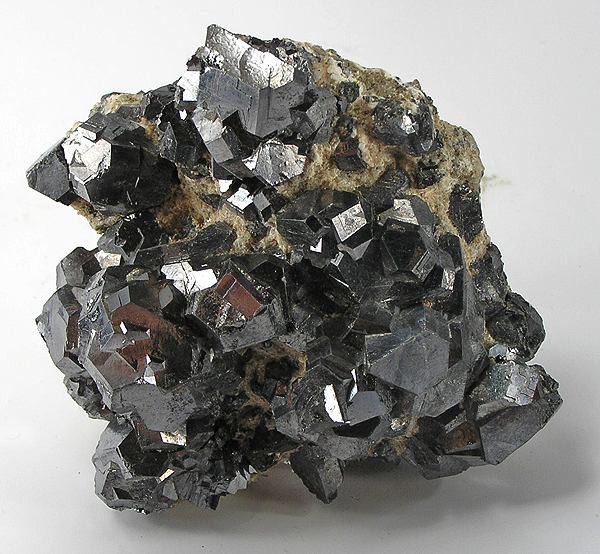
Large Naica galena specimen of many sharp, shiny crystals from the older mining, sparingly attached to matrix.
Photo: Robert M. Lavinsky · CC BY-SA 3.0 · Source

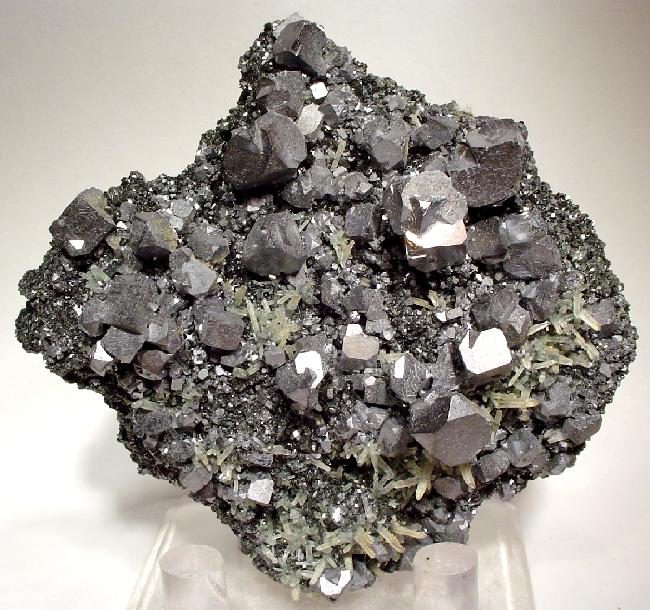
Plate of interpenetrating cuboctahedral galena crystals with small needle quartz crystals.
Photo: Robert M. Lavinsky · CC BY-SA 3.0 · Source

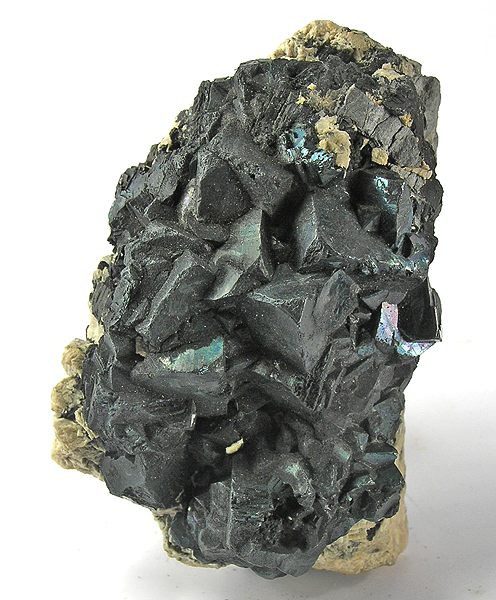
Cluster of old Neudorf galena crystals to 1.2 cm with a bluish tint, trimmed with a thin rim of matrix.
Photo: Robert M. Lavinsky · CC BY-SA 3.0 · Source

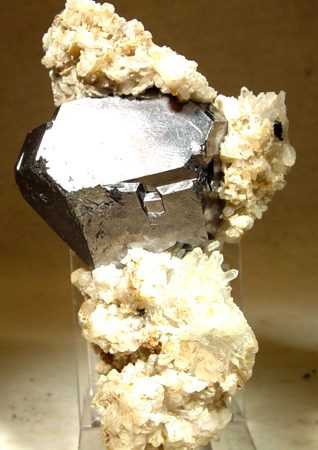
Single 4.5 cm galena crystal with sharp faces and bright metallic luster, seated in a bend of the matrix.
Photo: Robert M. Lavinsky · CC BY-SA 3.0 · Source

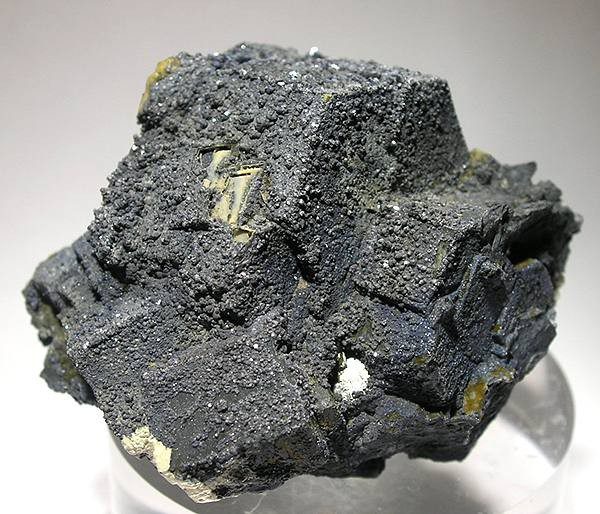
Galena pseudomorph after pyromorphite with crystals to 3 cm.
Photo: Robert M. Lavinsky · CC BY-SA 3.0 · Source

Where Galena is found (17)
Australia
- Broken Hill Pb-Zn-Ag depositNew South Wales · 2 photos
Bulgaria
- Krushev dol MineSmolyan Province · 3 photos
- Madan ore fieldSmolyan Province · 3 photos
Germany
- Kautenbach MineRhineland-Palatinate · 3 photos
- Neudorf (Harzgerode)Saxony-Anhalt · 3 photos
Ireland
- Mogul Mine (Garryard)County Tipperary · 3 photos
Kosovo
- Trepca complexMitrovica District
Mexico
- NaicaChihuahua · 3 photos
- Santa Eulalia Mining DistrictChihuahua · 2 photos
Namibia
- Tsumeb MineOshikoto Region · 3 photos
Russia
- DalnegorskPrimorsky Krai · 3 photos
United States
- Buick MineMissouri · 3 photos
- Elmwood Mine (Carthage, Smith County)Tennessee · 3 photos
- Joplin FieldMissouri · 2 photos
- Picher FieldOklahoma · 3 photos
- Sweetwater MineMissouri · 3 photos
- Viburnum TrendMissouri · 3 photos
Galena on the same specimen with other minerals
Gunmetal-grey galena cubes sit on a chalcopyrite matrix in specimens from the Buick Mine in the Viburnum Trend.
A bright metallic lead sulfide on a brassy copper sulfide gives a strong colour and luster contrast in a Mississippi Valley-type specimen.
Sources: SRC-047
Joplin marcasite is described as bladed brassy crystals, sometimes arranged in parallel orientation on grey galena cubes or octahedra; marcasite also lines corrosion cavities in galena.
The pale brassy blades against dark lead-grey galena is a classic Tri-State look and shows an oriented growth relationship.
Sources: SRC-015
Cabinet specimens from Madan show lustrous silver-grey galena crystals, many with skeletal or hopper-like modified cube forms and some spinel-twinned, on a matrix of needle-like quartz, with chalcopyrite also present.
The skeletal galena habit is typical of Madan, and the needle quartz base makes a dramatic, delicate display.
Sources: SRC-157
A Naica specimen shows gemmy purple amethyst crystals to about 3 cm rising from a bed of bright metallic galena crystals.
Deep purple amethyst on a shiny lead-grey base is a striking and unusual colour pairing.
Trepca specimens are shown that consist mainly of galena with slender quartz prisms, some with a small cluster of quartz prisms; the captions do not say which mineral grew first.
Slender quartz prisms combined with galena illustrate the sulfide and quartz vein assemblage of this famous ore belt.
Sources: SRC-061
A Tsumeb collection specimen of octahedral galena crystals (to 9 mm) occurs together with quartz and minor dolomite.
Sharp galena octahedra on a Tsumeb specimen carry the prestige of this classic African locality.
Sources: SRC-045
1 specimen photo(s) from this locality show marcasite with galena together. The pairing comes from the photographer's file name and label, so the relationship between the two minerals is not specified.
1 specimen photo(s) from this locality show chalcopyrite with galena together. The pairing comes from the photographer's file name and label, so the relationship between the two minerals is not specified.
1 specimen photo(s) from this locality show galena with calcite together. The pairing comes from the photographer's file name and label, so the relationship between the two minerals is not specified.
1 specimen photo(s) from this locality show galena with quartz together. The pairing comes from the photographer's file name and label, so the relationship between the two minerals is not specified.
1 specimen photo(s) from this locality show galena with sphalerite together. The pairing comes from the photographer's file name and label, so the relationship between the two minerals is not specified.
1 specimen photo(s) from this locality show galena with marcasite together. The pairing comes from the photographer's file name and label, so the relationship between the two minerals is not specified.
1 specimen photo(s) from this locality show galena with calcite together. The pairing comes from the photographer's file name and label, so the relationship between the two minerals is not specified.
1 specimen photo(s) from this locality show galena with sphalerite together. The pairing comes from the photographer's file name and label, so the relationship between the two minerals is not specified.
1 specimen photo(s) from this locality show galena with quartz together. The pairing comes from the photographer's file name and label, so the relationship between the two minerals is not specified.
1 specimen photo(s) from this locality show galena with calcite together. The pairing comes from the photographer's file name and label, so the relationship between the two minerals is not specified.
1 specimen photo(s) from this locality show galena with fluorite together. The pairing comes from the photographer's file name and label, so the relationship between the two minerals is not specified.
2 specimen photo(s) from this locality show galena with sphalerite together. The pairing comes from the photographer's file name and label, so the relationship between the two minerals is not specified.
2 specimen photo(s) from this locality show sphalerite with galena together. The pairing comes from the photographer's file name and label, so the relationship between the two minerals is not specified.
2 specimen photo(s) from this locality show sphalerite with galena together. The pairing comes from the photographer's file name and label, so the relationship between the two minerals is not specified.
1 specimen photo(s) from this locality show sphalerite with galena together. The pairing comes from the photographer's file name and label, so the relationship between the two minerals is not specified.
1 specimen photo(s) from this locality show sphalerite with galena together. The pairing comes from the photographer's file name and label, so the relationship between the two minerals is not specified.
1 specimen photo(s) from this locality show galena with dolomite together. The pairing comes from the photographer's file name and label, so the relationship between the two minerals is not specified.
1 specimen photo(s) from this locality show galena with dolomite together. The pairing comes from the photographer's file name and label, so the relationship between the two minerals is not specified.
1 specimen photo(s) from this locality show galena with pyrrhotite together. The pairing comes from the photographer's file name and label, so the relationship between the two minerals is not specified.
1 specimen photo(s) from this locality show galena with siderite together. The pairing comes from the photographer's file name and label, so the relationship between the two minerals is not specified.
2 specimen photo(s) from this locality show siderite with galena together. The pairing comes from the photographer's file name and label, so the relationship between the two minerals is not specified.
1 specimen photo(s) from this locality show pyrrhotite with galena together. The pairing comes from the photographer's file name and label, so the relationship between the two minerals is not specified.
1 specimen photo(s) from this locality show pyrrhotite with galena together. The pairing comes from the photographer's file name and label, so the relationship between the two minerals is not specified.
1 specimen photo(s) from this locality show pyrrhotite with galena together. The pairing comes from the photographer's file name and label, so the relationship between the two minerals is not specified.
1 specimen photo(s) from this locality show pyrrhotite with galena together. The pairing comes from the photographer's file name and label, so the relationship between the two minerals is not specified.
1 specimen photo(s) from this locality show rhodochrosite with galena together. The pairing comes from the photographer's file name and label, so the relationship between the two minerals is not specified.
Identity
- Group
- Galena Group
- Strunz
- 2.CD.10 · 2 Sulfides and sulfosalts
- IMA status
- Grandfathered
- Name origin
- From Latin 'galena', the name for lead ore or for the dross left when lead is smelted; Pliny the Elder used it in the first century AD.
- Elements
- Pb, S
Physical properties
- Color
- Lead-gray; fresh crystal faces are bright but often tarnish in air
- Streak
- Lead-gray
- Luster
- Metallic luster
- Transparency
- Opaque
- Mohs hardness
- 2.5–2.75
- Density
- 7.57–7.58 g/cm³
- Cleavage / fracture
- Perfect cubic cleavage on {001}; parting or cleavage on {111}; fracture subconchoidal; brittle
- Magnetism / fluorescence
- Not fluorescent under UV; a tested Viburnum Trend specimen was not noticeably magnetic
Crystallography
- Crystal system
- Cubic
- Space group
- Fm-3m
- Structure
- Rock-salt (halite-type) structure: Pb2+ and S2- ions each form a face-centred cubic arrangement; a = 5.936 Angstrom, Z = 4.
- Typical habit
- Cube (crystals up to about 1 m on an edge reported); also cubo-octahedron and octahedron, rarely tabular on {001}; skeletal and reticulated crystals; coarse to fine granular masses; fibrous or plumose aggregates
- Twinning
- Spinel-law twins on {111} (contact and penetration); lamellar twinning on {114}
- Optical data
- Opaque; white in polished section; reflectance about 52% at 400 nm, falling to about 43% between 600 and 700 nm
Formation and use
- Formation
- Hydrothermal veins over a wide temperature range, contact-metamorphic (skarn) deposits and low-temperature lead-zinc deposits in limestone and dolostone; rare in pegmatites. Silver-bearing galena is almost entirely hydrothermal.
- Uses
- Principal ore of lead and an important source of silver; used for lead in batteries and ceramic glazes, historically for kohl, and as a point-contact detector in early crystal radios; collector's specimen.
- Stability and care
- Weathers to anglesite (lead sulfate) and cerussite (lead carbonate); bright faces tarnish on exposure to air; attacked by strong nitric acid.
Related minerals
- Related minerals
- Clausthalite (forms a solid-solution series with galena)alabanditealtaiteniningeriteoldhamite (galena group)
Sources
- SRC-042 · Book
Handbook of Mineralogy - GalenaAnthony, J.W.; Bideaux, R.A.; Bladh, K.W.; Nichols, M.C. · Mineralogical Society of America - SRC-043 · Website
GalenaWikipedia - SRC-044 · Database
Galena: Mineral information, data and localities.Mindat.org (zh mirror) - SRC-048 · Website
Galena from two mining camps in North AmericaTurnstone Geological Services (turnstone.ca)
Draft data from the Provenite workbook. Check entries against the cited sources before relying on them. Photos are open-licence images from Wikimedia Commons; the author and licence are given with each photo.