About Rose quartz
SiO₂
Two different materials share the name. Massive rose quartz is coloured by microscopic fibres, about 0.1 to 0.5 micrometres wide, of a pink phase related to dumortierite; the pink arises from Fe-Ti charge transfer, and some material shows six-rayed asterism. Rare euhedral pink quartz instead owes its colour to irradiation-induced aluminium and phosphorus colour centres and has no such fibres. Natural irradiation can add a grey or smoky tint to massive material. Synthetic pink quartz has been grown hydrothermally since the 1990s.
Photos of Rose quartz
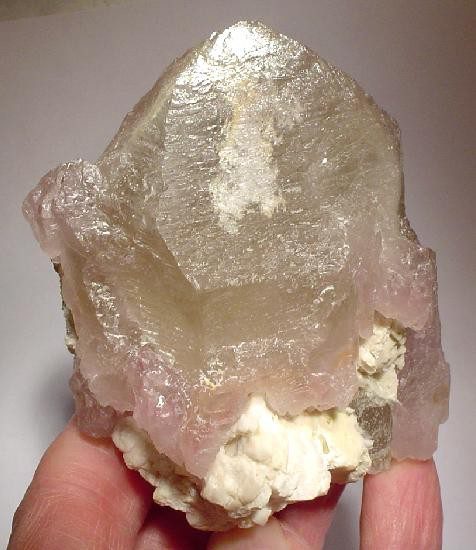
Glassy rose quartz crystals on a large, sharply terminated smoky quartz crystal from Berilo Branco, 8.5 cm across.
Photo: Robert M. Lavinsky · CC BY-SA 3.0 · Source

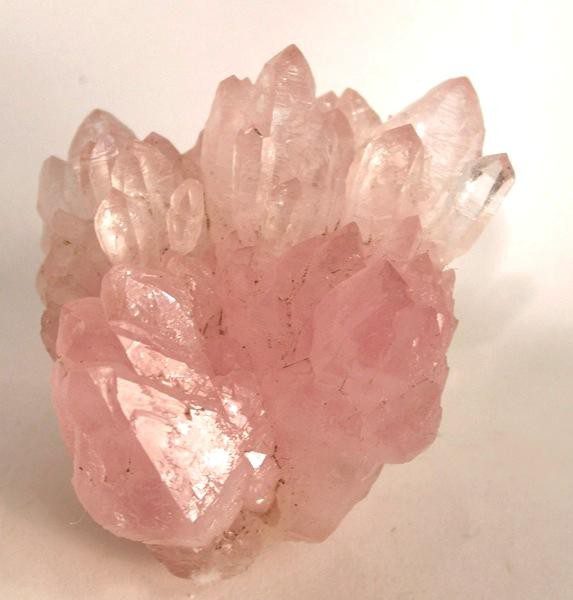
Rose quartz cluster of two generations, slender pale spires above stouter vivid pink crystals, from the Ilha claim, 4.5 cm.
Photo: Robert M. Lavinsky · CC BY-SA 3.0 · Source

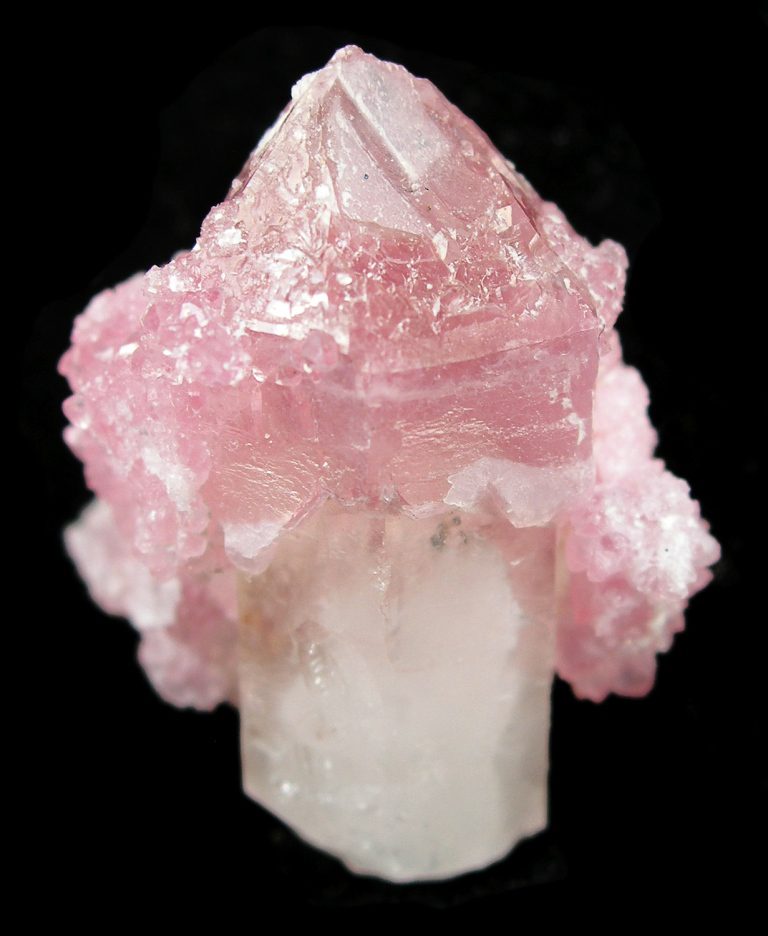
Thumbnail rose quartz scepter on quartz from a 2009 pocket at Mount Mica Quarry, 2.3 cm.
Photo: Robert M. Lavinsky · CC BY-SA 3.0 · Source

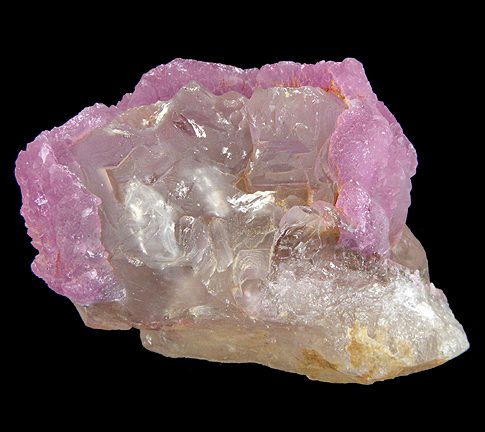
Rose quartz with smoky quartz from the Dara-i-Pech pegmatite field, Afghanistan, 5.0 cm.
Photo: Robert M. Lavinsky · CC BY-SA 3.0 · Source

Where Rose quartz is found (8)
Afghanistan
- Darra-i-Pech pegmatite fieldNangarhar · 1 photo
Brazil
- Berilo Branco claimMinas Gerais · 3 photos
- Ilha claim (Lavra da Ilha)Minas Gerais · 3 photos
Canada
Madagascar
- Vohibola pegmatites (Mangarano, Antsirabe II)Vakinankaratra
United States
- Dunton Gem QuarryMaine
- Mount Mica QuarryMaine · 2 photos
- Pink Panther MineSouth Dakota
Identity
- Variety of
- Quartz
- Also called
- Pink quartz (euhedral crystals); Rosaquarz (German)
- Strunz
- 4.DA.05 · 4 Oxides and hydroxides
- IMA status
- Variety
- Name origin
- Descriptive colour name; the German term for pink quartz is Rosaquarz.
- Elements
- Si, O
Physical properties
- Color
- Pale pink to deep rose-red
- Luster
- Vitreous luster
- Transparency
- Translucent
- Mohs hardness
- 7
- Density
- 2.65–2.66 g/cm³
- Cleavage / fracture
- Cleavage rarely observable and poor on {10-11}, {01-11} and {10-10}; rhombohedral parting; fracture conchoidal
Crystallography
- Crystal system
- Trigonal
- Space group
- P3₁21 or P3₂21
- Typical habit
- Usually massive, anhedral, hazy translucent grain aggregates (the lapidary type); well-formed hexagonal crystals ('pink quartz') are rare and form late in pegmatite pockets, often overgrowing smoky quartz
- Twinning
- Very common: Dauphiné and Brazil penetration twins, Japan contact twins
- Optical data
- Uniaxial (+); omega = 1.544, epsilon = 1.553
Formation and use
- Formation
- Massive rose quartz typically forms in the core zones of pegmatites together with feldspar, colourless quartz, mica and often tourmaline; it also occurs in at least one non-pegmatitic quartz vein. Euhedral pink quartz crystallises late in open pegmatite pockets.
- Uses
- Cut and polished for carving, beads and jewellery; beads about 7,000 years old are known. Euhedral pink quartz is a collector's mineral.
- Stability and care
- Massive rose quartz keeps its colour to roughly 500-575 degrees C and is generally stable in UV light, although a few specimens reportedly fade in daylight. Euhedral pink quartz is much more sensitive: it pales around 200 degrees C, and one natural specimen bleached completely within 10 hours of UV exposure, so keep it in the dark. Reports on fading of massive material conflict, so avoid prolonged strong light.
Related minerals
- Related minerals
- Quartzsmoky quartzamethystcitrinedumortierite (fibrous inclusions)
- Can be confused with
- Pale amethyst (separate free crystals by dichroism: pink quartz shifts from paler to more intense pink, amethyst from bluish to reddish)synthetic pink quartz (tabular shape, colour bands parallel to the basal faces)large 'rose quartz blocks' sold online are likely pink travertine
Sources
- SRC-084 · Book
Handbook of Mineralogy - QuartzAnthony, J.W.; Bideaux, R.A.; Bladh, K.W.; Nichols, M.C. · 2001 · Mineralogical Society of America / Mineral Data Publishing - SRC-085 · Database
Quartz (Mindat.org mineral page)Mindat.org / Hudson Institute of Mineralogy - SRC-123 · Database
Rose Quartz: Mineral information, data and localitiesMindat.org contributors · Mindat.org - SRC-124 · Article
Fibrous nanoinclusions in massive rose quartz: The origin of rose colorationGoreva, J.S.; Ma, C.; Rossman, G.R. · 2001 · American Mineralogist 86(4), 466-472 - SRC-125 · Article
Rose Quartz: Journey Into the Nano-JungleFox, K.E.; McDonald, A.M. · 2023 · 37th International Gemmological Conference (IGC), Tokyo - SRC-148 · Article
Global Mining Review and Potentially Economic Deposits - Rose QuartzKrassmann, T. · 2022 · Mineral & Exploration, Bad Windsheim - SRC-153 · Article
Russian Synthetic Pink QuartzBalitsky, V.S.; Makhina, I.B.; Mar'in, A.A.; Fritsch, E.; McClure, S.F.; DeGhionno, D.; Koivula, J.I.; Shigley, J.E. · 1998 · Gems & Gemology 34(1), Spring 1998
Draft data from the Provenite workbook. Check entries against the cited sources before relying on them. Photos are open-licence images from Wikimedia Commons; the author and licence are given with each photo.