About Smoky quartz
SiO₂
Smoky quartz is the grey-to-brown to black variety of quartz. Its colour comes from aluminium-based colour centres that are produced by natural irradiation, for example from radioactive elements in the surrounding rock. In polarized light it is dichroic, shifting from darker yellow-brown to lighter red-brown. Black or brown quartz that owes its colour to mineral inclusions or organic matter is often mislabelled as smoky quartz or morion.
Photos of Smoky quartz
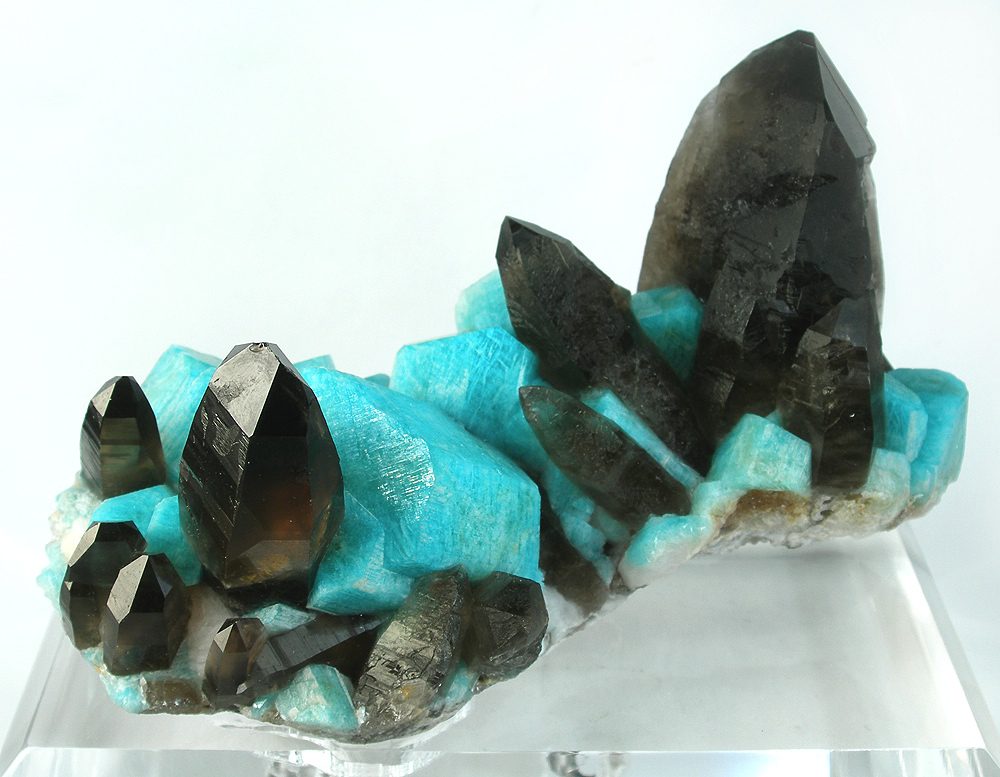
Cabinet-size smoky quartz crystals on green amazonite (specimen from Florissant area, Teller County, Colorado, USA).
Photo: Robert M. Lavinsky · CC BY-SA 3.0 · Source

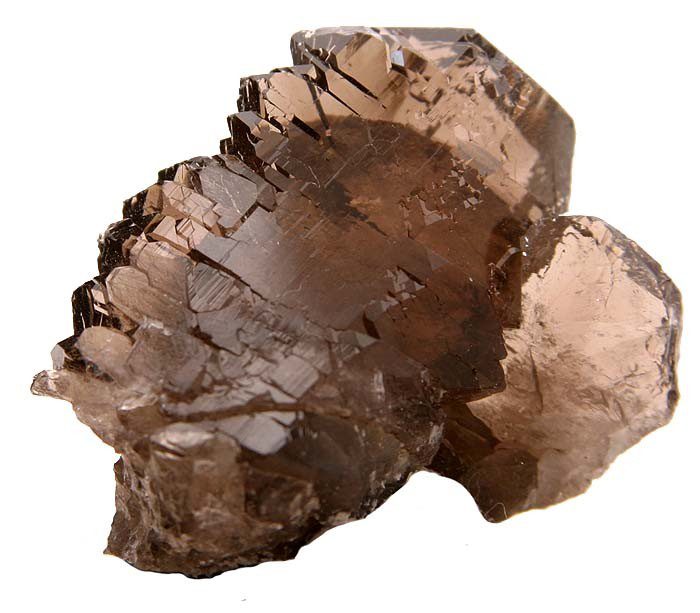
Twisted smoky quartz crystal (gwindel) with a serrated edge (specimen from Graubünden, Switzerland).
Photo: Robert M. Lavinsky · CC BY-SA 3.0 · Source

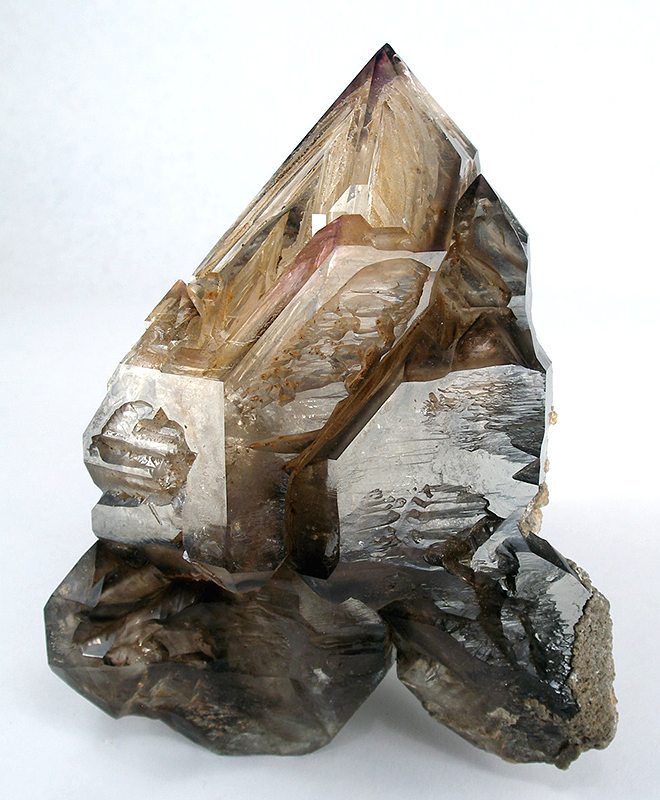
Solid smoky quartz specimen with sceptred, hoppered skeletal growth.
Photo: Robert M. Lavinsky · CC BY-SA 3.0 · Source

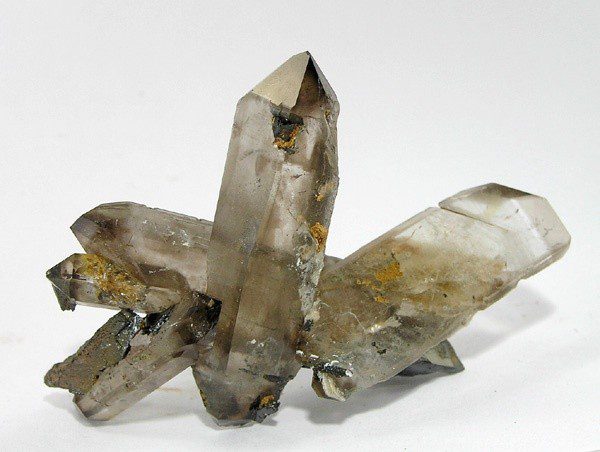
Floater cluster of smoky quartz crystals ranging from prismatic to tabular, labelled Erongo Mountain.
Photo: Robert M. Lavinsky · CC BY-SA 3.0 · Source

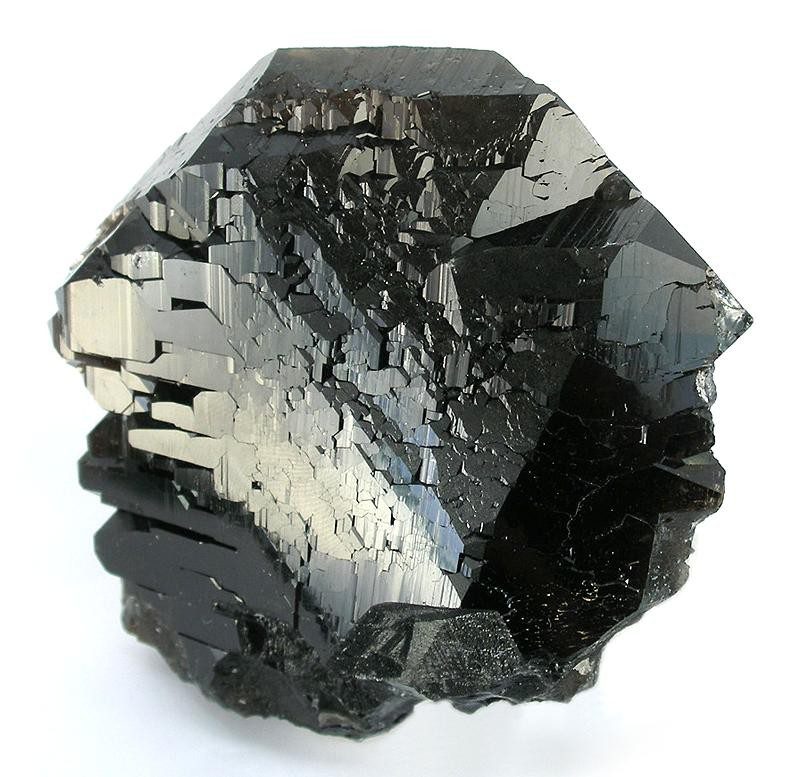
Deeply coloured smoky quartz gwindel (twisted crystal), labelled Göschenen Valley.
Photo: Robert M. Lavinsky · CC BY-SA 3.0 · Source

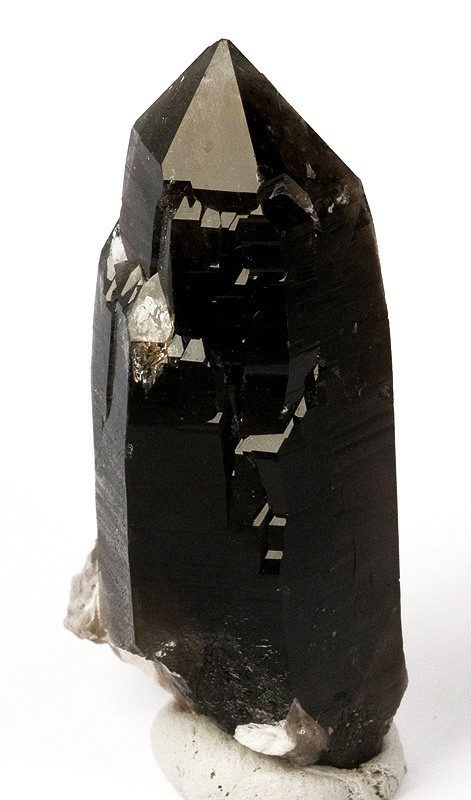
Lustrous, gemmy dark smoky quartz crystal with accenting matrix, labelled Papachacra.
Photo: Robert M. Lavinsky · CC BY-SA 3.0 · Source

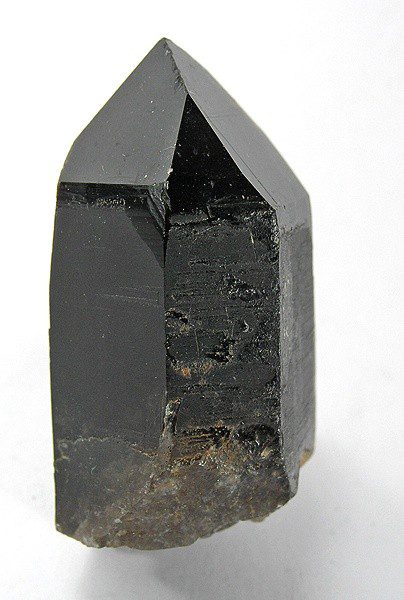
Old smoky quartz crystal, labelled Conway, New Hampshire.
Photo: Robert M. Lavinsky · CC BY-SA 3.0 · Source

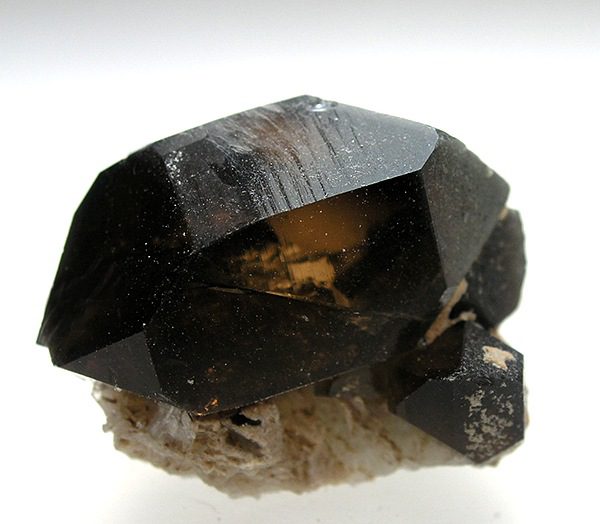
Small gemmy smoky quartz crystal, labelled Little Three Mine.
Photo: Robert M. Lavinsky · CC BY-SA 3.0 · Source

Where Smoky quartz is found (15)
Argentina
- PapachacraCatamarca · 3 photos
Namibia
- Erongo MountainErongo · 3 photos
- Goboboseb MountainsErongo · 4 photos
Switzerland
- Gletschhorn smoky quartz cleftUri
- GraubündenGraubünden · 4 photos
- Göschenen ValleyUri · 3 photos
- PlanggenstockUri
- St Gotthard pass area (Central St Gotthard Massif)Ticino · 3 photos
- Val Giuv (Tujetsch)Graubünden · 3 photos
United Kingdom
United States
- Conway (Redstone area), Carroll CountyNew Hampshire · 3 photos
- Florissant area (Teller County)Colorado · 4 photos
- Little Three MineCalifornia · 3 photos
- Smoky Hawk claimColorado · 2 photos
- Wegner Quartz Crystal MinesArkansas
Identity
- Variety of
- Quartz
- Also called
- Morion (black smoky quartz); cairngorm (Scottish name for wine-yellow to brown smoky quartz)
- Strunz
- 4.DA.05 · 4 Oxides and hydroxides
- IMA status
- Variety
- Elements
- Si, O
Physical properties
- Color
- Smoky grey, brown to black; the black end is called morion
- Luster
- Vitreous luster
- Transparency
- Variable
- Mohs hardness
- 7
- Density
- 2.65–2.66 g/cm³
- Cleavage / fracture
- Cleavage rarely observable and poor on {10-11}, {01-11} and {10-10}; rhombohedral parting; fracture conchoidal
Crystallography
- Crystal system
- Trigonal
- Space group
- P3₁21 or P3₂21
- Typical habit
- Prismatic crystals with rhombohedral terminations, as euhedral crystals grown into open cavities (granite, pegmatite, Alpine clefts); also rolled crystals in river gravels
- Twinning
- Very common: Dauphiné and Brazil penetration twins, Japan contact twins
- Optical data
- Uniaxial (+); omega = 1.544, epsilon = 1.553
Formation and use
- Formation
- Grows as free-standing crystals in open cavities: miarolitic cavities in granite and in pegmatite pockets, Alpine fissures (clefts) in granitic massifs, cavities in volcanic rocks, and veins in sandstone. The shade depends on how strongly the crystal was exposed to natural radiation from the surrounding granite.
- Uses
- Collector's specimens and gem or ornamental material; cairngorm gemstones from the Cairngorm Mountains supported a notable 19th-century local gem industry.
- Stability and care
- Most smoky quartz is naturally coloured, but some of the darker stones on the market are made by exposing clear quartz to gamma rays. Heating can destroy the colour centres, and the colour is reported to pale in sunlight only after a very long time. Do not heat, and avoid long exposure to strong light and heat.
Related minerals
- Related minerals
- Quartzrock crystalamethystcitrineprasioliterose quartz
- Can be confused with
- Black or brown quartz coloured by inclusions or organic matterbrown topaz (harder)brown diamond (much harder)black schorl tourmaline and melanite garnet (always opaque)
Sources
- SRC-084 · Book
Handbook of Mineralogy - QuartzAnthony, J.W.; Bideaux, R.A.; Bladh, K.W.; Nichols, M.C. · 2001 · Mineralogical Society of America / Mineral Data Publishing - SRC-085 · Database
Quartz (Mindat.org mineral page)Mindat.org / Hudson Institute of Mineralogy - SRC-122 · Database
Smoky Quartz: Mineral information, data and localitiesMindat.org contributors · Mindat.org - SRC-126 · Website
Smoky quartz: The brown gemstone smoky quartz information and picturesMinerals.net · Minerals.net - SRC-127 · Website
Loch Avon (GCR 708) geositeScottish Geology Trust · Scottish Geology Trust GeoSites - SRC-128 · Website
Loch Avon GeoGuide page (Cairngorm Pluton granite)Scottish Geology Trust · Scottish Geology Trust GeoGuide - SRC-133 · Museum / collection
Info brochure: The Planggenstock treasure (EN)Natural History Museum Bern · Naturhistorisches Museum Bern - SRC-136 · Database
Hawk Feathers pocket, Smoky Hawk claim, Crystal Peak, Teller County, Colorado, USAMindat.org contributors · Mindat.org
Draft data from the Provenite workbook. Check entries against the cited sources before relying on them. Photos are open-licence images from Wikimedia Commons; the author and licence are given with each photo.