About Amethyst
SiO₂
The violet to purple variety of quartz. The colour is caused by a trace of iron (typically 10-100 ppm) replacing silicon in the lattice, which forms an [FeO4]0 colour centre after natural gamma irradiation; Fe, not Si or O, is the colour agent and so is not listed under Elements. It is pleochroic (blue-violet to purple depending on the direction relative to the c-axis). Colour distribution is frequently patchy, with phantom layers and concentration along crystal edges. Synthetic amethyst exists; growth zoning and Brazil-law twinning in natural crystals help to separate it from synthetic material.
Photos of Amethyst
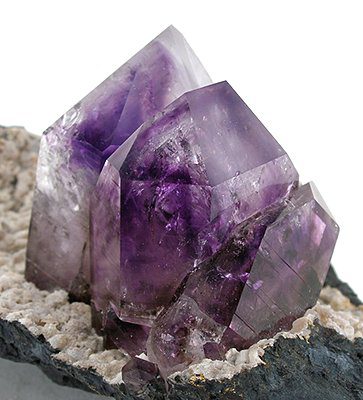
Amethyst crystals up to 4.5 cm in a calcite-lined cavity on matrix.
Photo: Robert M. Lavinsky · CC BY-SA 3.0 · Source

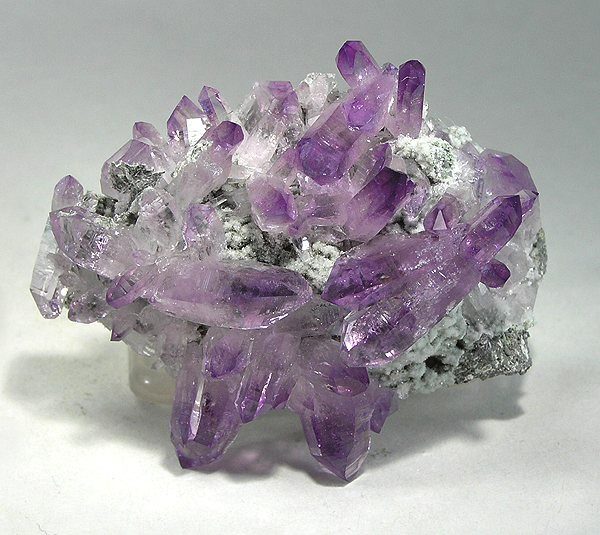
Amethyst crystals lying across a rounded matrix, many with both ends developed, from Piedra Parada, Veracruz, Mexico.
Photo: Robert M. Lavinsky · CC BY-SA 3.0 · Source

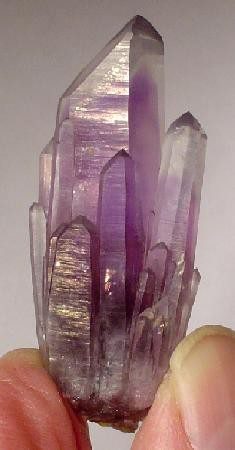
Small cluster of amethyst crystals with colour zoning, about 5 cm, from Amatitlan, Guerrero, Mexico.
Photo: Robert M. Lavinsky · CC BY-SA 3.0 · Source

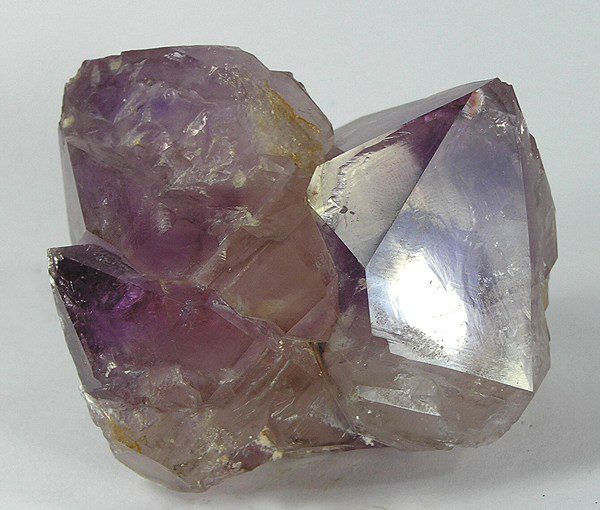
Cluster of intergrown bright purple amethyst crystals with glassy luster from Jacksons Crossroads, Georgia.
Photo: Robert M. Lavinsky · CC BY-SA 3.0 · Source

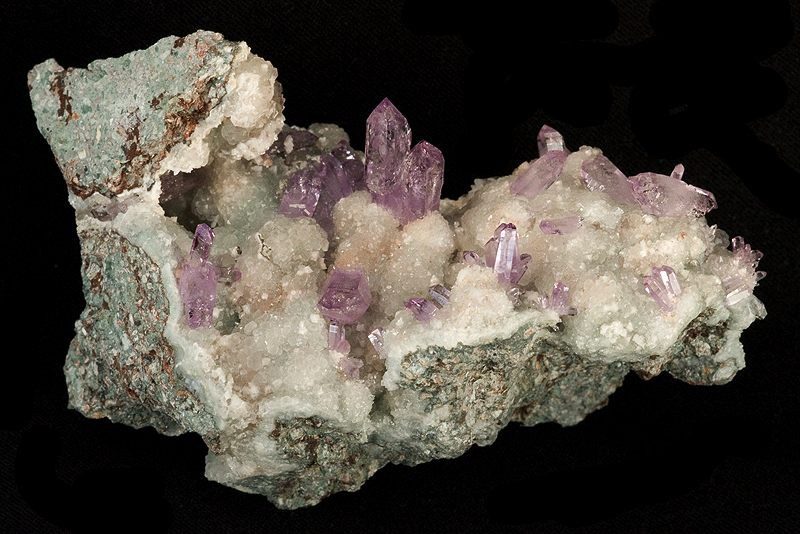
Sharp amethyst crystals on matrix, the largest 1.7 cm, from the Capurru Quarry near Osilo, Sardinia.
Photo: Robert M. Lavinsky · CC BY-SA 3.0 · Source

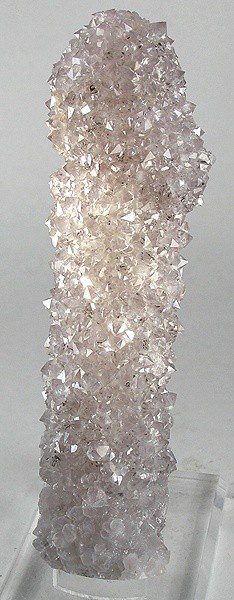
Amethyst stalactite about 18 cm long with crystals around the outside and a polished base showing growth rings, from Artigas, Uruguay.
Photo: Robert M. Lavinsky · CC BY-SA 3.0 · Source

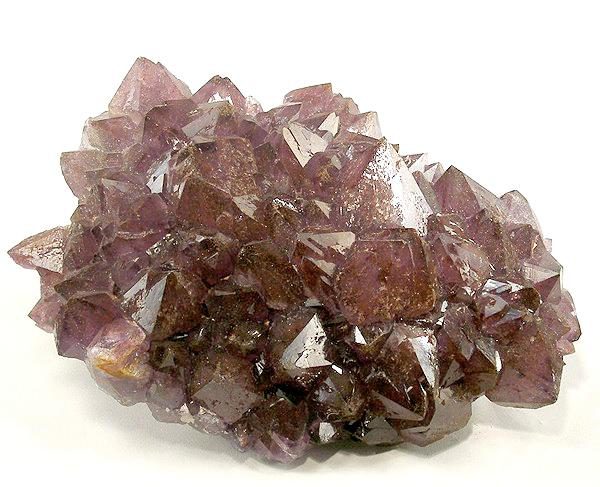
Cabinet specimen of glassy purple amethyst crystals, the largest 3.1 cm across, from the Diamond Willow Mine near Pearl, Ontario.
Photo: Robert M. Lavinsky · CC BY-SA 3.0 · Source

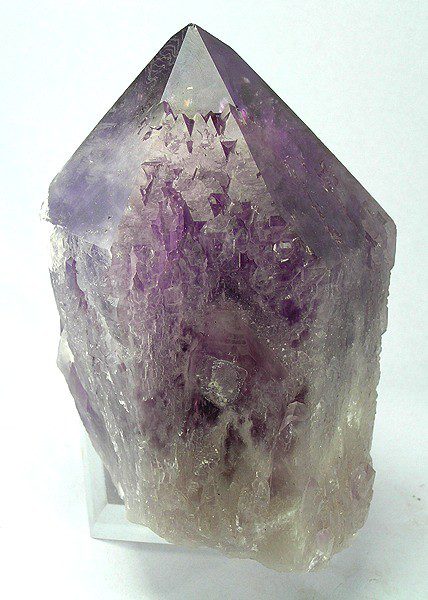
Large single amethyst crystal about 16 cm long with a gemmy purple top, from the Anahi mine, Bolivia.
Photo: Robert M. Lavinsky · CC BY-SA 3.0 · Source

Where Amethyst is found (15)
Bolivia
- Anahi MineSanta Cruz · 3 photos
Brazil
- Ametista do SulRio Grande do Sul
Canada
- Diamond Willow Mine (Pearl Station)Ontario · 3 photos
- Thunder Bay Amethyst Panorama (Amethyst Mine)Ontario
Italy
- Capurru Quarry (Osilo)Sardinia · 3 photos
Mexico
- Amatitlan amethyst veins (Eduardo Neri)Guerrero · 3 photos
- NaicaChihuahua
- Piedra Parada (Tatatila)Veracruz · 3 photos
Namibia
- Goboboseb MountainsErongo · 4 photos
Romania
- CavnicMaramures County
Russia
- Bor Pit (Dal'negorsk B deposit)Primorsky Krai · 3 photos
United States
- Four Peaks Amethyst MineArizona · 1 photo
- Jackson Crossroads Amethyst MineGeorgia · 3 photos
Uruguay
- Los Catalanes Gemological DistrictArtigas · 3 photos
Zambia
- MapatizyaSouthern Province
Amethyst on the same specimen with other minerals
A Naica specimen shows gemmy purple amethyst crystals to about 3 cm rising from a bed of bright metallic galena crystals.
Deep purple amethyst on a shiny lead-grey base is a striking and unusual colour pairing.
A large Cavnic specimen carries pastel purple, lightly frosted amethyst clusters to about 5 cm on a plate covered with brass-yellow striated pyrite crystals.
Amethyst of this size is described as rare from the Cavnic mines, and the golden pyrite base adds contrast.
On the same type of Cavnic plate, iridescent brassy chalcopyrite crystals occur on the matrix together with the pyrite, and the amethyst clusters rise from this sulfide-covered matrix.
The iridescent chalcopyrite adds a second metallic colour beneath the purple quartz.
Identity
- Variety of
- Quartz
- Strunz
- 4.DA · 4 Oxides and hydroxides
- IMA status
- Variety
- Name origin
- From Greek 'a-methystos': not drunk.
- Elements
- Si, O
Physical properties
- Color
- Violet to purple; colour often uneven and strongest in growth zones under the rhombohedral faces
- Streak
- White
- Luster
- Vitreous luster
- Transparency
- Variable
- Mohs hardness
- 7
- Density
- 2.65–2.66 g/cm³
- Cleavage / fracture
- Cleavage rarely observable and poor; fracture conchoidal; brittle
Crystallography
- Crystal system
- Trigonal
- Space group
- P3121 or P3221 (enantiomorphic pair)
- Structure
- Framework of corner-sharing SiO4 tetrahedra (tectosilicate); cell a = 4.9135 Å, c = 5.4050 Å, Z = 3.
- Typical habit
- Druzy aggregates, scepters, split-growth 'artichoke' quartz, single well-formed prismatic crystals, and banded vein fillings; crystals longer than 30 cm are very rare
- Twinning
- Polysynthetic Brazil-law twinning is common, typically beneath the positive rhombohedral (r) faces; other quartz twin laws (Dauphine, Japan) also occur
- Optical data
- Uniaxial (+); omega = 1.544, epsilon = 1.553; birefringence about 0.009
Formation and use
- Formation
- Grows in open cavities: as linings of geodes in flood basalt (low-temperature, groundwater-related growth at roughly 15-60 C in Uruguay), in cavities and fractures in brecciated quartzite, in vugs along faults and quartz veins in granitic rock, and in banded hydrothermal vein fillings.
- Uses
- Faceted gemstone and ornamental material; geodes and crystal groups are collected as specimens.
- Stability and care
- Heating above about 300-400 C removes the violet colour and usually gives yellow, orange or brown material that resembles citrine (colourless or, rarely, green material is also possible). Ultraviolet light destroys the colour centres, so prolonged sunlight slowly fades amethyst. Keep specimens out of strong light. Broken edges are sharp, and dry grinding produces hazardous quartz dust.
Related minerals
- Polymorphs
- Cristobalitetridymitecoesitestishovite
- Can be confused with
- Synthetic amethyst (hydrothermally grown)citrine (including heated amethyst)
Sources
- SRC-084 · Book
Handbook of Mineralogy - QuartzAnthony, J.W.; Bideaux, R.A.; Bladh, K.W.; Nichols, M.C. · 2001 · Mineralogical Society of America / Mineral Data Publishing - SRC-085 · Database
Quartz (Mindat.org mineral page)Mindat.org / Hudson Institute of Mineralogy - SRC-099 · Database
Amethyst: Mineral information, data and localitiesMindat.org - SRC-101 · Website
Citrine DescriptionGemological Institute of America (GIA) - SRC-107 · Article
Amethyst from Four Peaks, ArizonaLowell, G.R. (author as given in the URL; not verified) · 2004 · Gems & Gemology (Winter 2004)
Draft data from the Provenite workbook. Check entries against the cited sources before relying on them. Photos are open-licence images from Wikimedia Commons; the author and licence are given with each photo.