About Vanadinite
Pb₅(VO₄)₃Cl
A lead chlorovanadate best known for bright red to orange hexagonal crystals with a resinous to subadamantine luster; hardness is low and the density very high.
Photos of Vanadinite
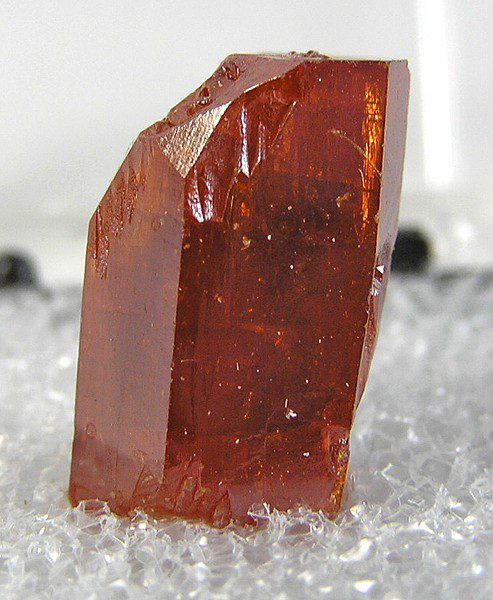
Single sharp burnt-orange vanadinite crystal from the Old Yuma Mine, Tucson Mountains, Arizona.
Photo: Robert M. Lavinsky · CC BY-SA 3.0 · Source

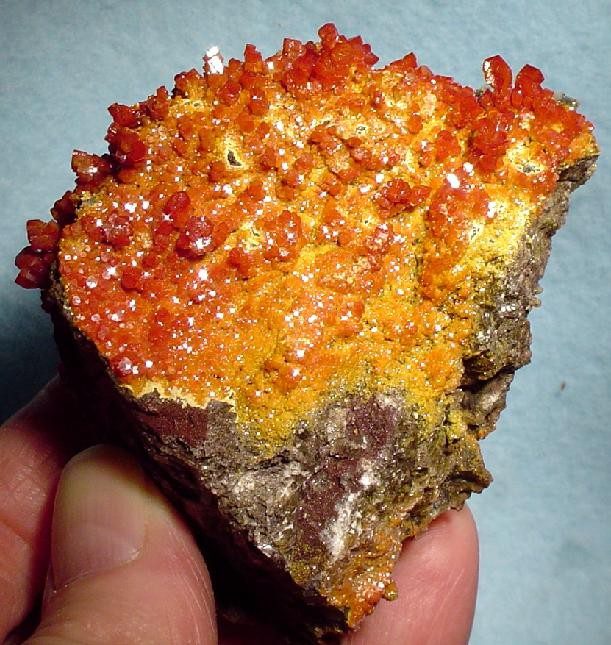
Red lustrous vanadinite crystals covering matrix, Pure Potential (North Geronimo) Mine, Arizona.
Photo: Robert M. Lavinsky · CC BY-SA 3.0 · Source

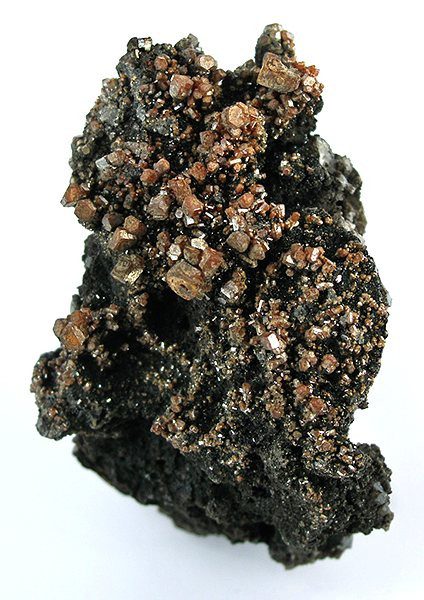
Orange-brown barrel-shaped vanadinite crystals on vuggy limonite from the Mammoth-St. Anthony Mine, Arizona.
Photo: Robert M. Lavinsky · CC BY-SA 3.0 · Source

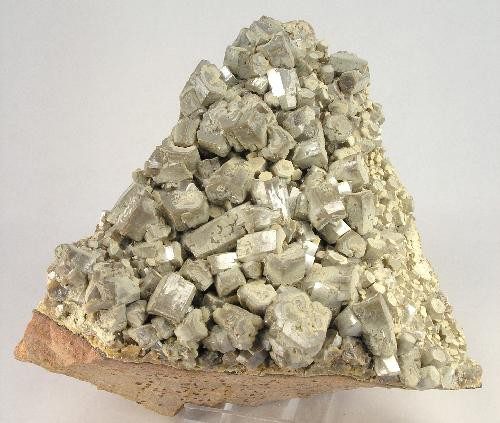
Plate covered with tan-gray barrel-shaped, partly hoppered vanadinite crystals from Touissit, Morocco.
Photo: Robert M. Lavinsky · CC BY-SA 3.0 · Source

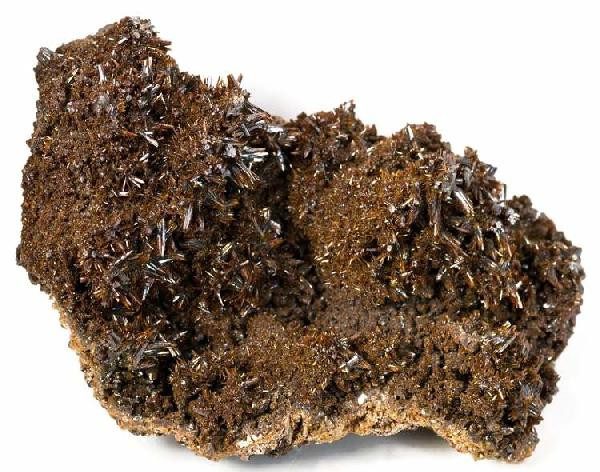
Crust of lustrous honey-brown to chocolate-brown vanadinite prisms from the Erupcion (Ahumada) Mine, Chihuahua, Mexico.
Photo: Robert M. Lavinsky · CC BY-SA 3.0 · Source

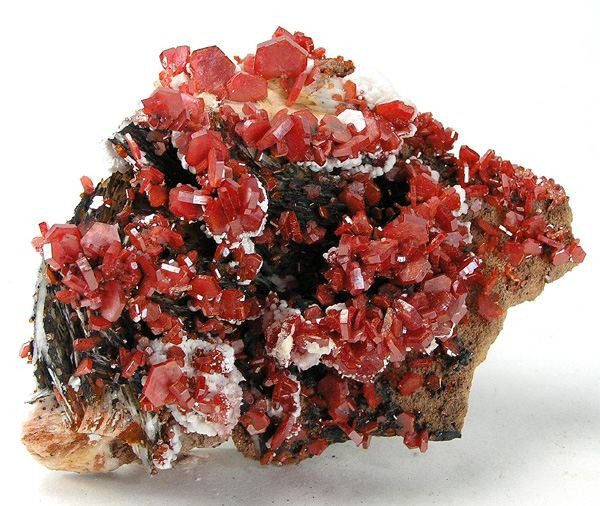
Bright red vanadinite crystals on bladed barite matrix from Mibladen, Morocco.
Photo: Robert M. Lavinsky · CC BY-SA 3.0 · Source

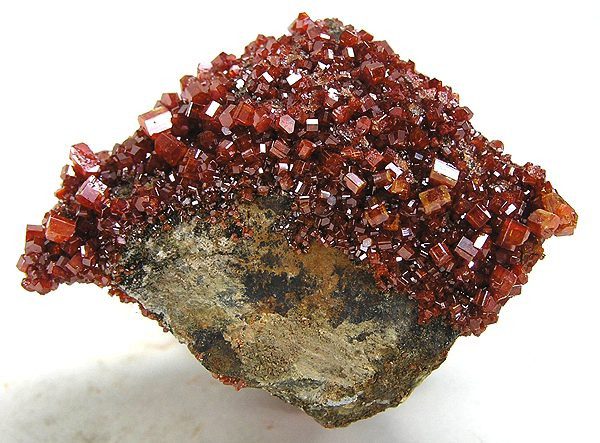
Vanadinite specimen from the Apache Mine, Gila County, Arizona.
Photo: Robert M. Lavinsky · CC BY-SA 3.0 · Source

Where Vanadinite is found (11)
Mexico
- Los Lamentos Mountains (Ahumada mine area)Chihuahua · 3 photos
- ZimapánHidalgo
Morocco
- Mibladen Mining DistrictDrâa-Tafilalet · 3 photos
- Touissit (Touissit-Bou Beker district)Oriental · 3 photos
Namibia
- AbenabOtjozondjupa Region
United States
- Apache MineArizona · 3 photos
- Mammoth-Saint Anthony Mine (Tiger)Arizona · 3 photos
- Old Yuma MineArizona · 3 photos
- Pure Potential Mine (North Geronimo Mine)Arizona · 3 photos
- Sierra Bella GroupNew Mexico
Zambia
- Kabwe Mine (Broken Hill)Central Province
Vanadinite on the same specimen with other minerals
1 specimen photo(s) from this locality show vanadinite with calcite together. The pairing comes from the photographer's file name and label, so the relationship between the two minerals is not specified.
1 specimen photo(s) from this locality show vanadinite with calcite together. The pairing comes from the photographer's file name and label, so the relationship between the two minerals is not specified.
1 specimen photo(s) from this locality show vanadinite with quartz together. The pairing comes from the photographer's file name and label, so the relationship between the two minerals is not specified.
Identity
- Also called
- johnstonite; brown lead (historical name)
- Group
- Apatite Group
- Strunz
- 8.BN.05 · 8 Phosphates, arsenates, vanadates
- IMA status
- Grandfathered
- Name origin
- Named for its vanadium content; the mineral was first recognised in Mexico in 1801 by del Rio as 'brown lead', before vanadium was accepted as an element.
- Elements
- Pb, V, O, Cl
Physical properties
- Color
- Red-orange, deep red, brownish red, brownish yellow, yellow or pale straw-yellow; may be concentrically zoned
- Streak
- White to pale red or pale yellow
- Luster
- Resinous luster
- Transparency
- Variable
- Mohs hardness
- 2.5–3
- Density
- 6.88–6.95 g/cm³
- Cleavage / fracture
- No cleavage reported; fracture uneven to conchoidal; brittle
- Magnetism / fluorescence
- Non-fluorescent
Crystallography
- Crystal system
- Hexagonal
- Space group
- P6₃/m
- Structure
- Apatite-type structure (point group 6/m, Z = 2, a = 10.3174, c = 7.3378), isostructural with pyromorphite and mimetite and forming solid-solution series with both.
- Typical habit
- Hexagonal prisms (short to long), often cavernous or in parallel groups; also acicular, hairlike or fibrous; rarely rounded or globular
- Optical data
- Uniaxial (-); omega about 2.416, epsilon about 2.35; absorption E < O
Formation and use
- Formation
- Secondary mineral of the oxidized zone of lead deposits, typically in arid climates, where vanadium leached from wall-rock silicates combines with lead released from galena; often found with mimetite, pyromorphite, descloizite, mottramite, wulfenite, cerussite and barite.
- Uses
- Minor ore of vanadium and lead; mainly valued as a collector's specimen for its colour.
- Stability and care
- Soluble in nitric and hydrochloric acid, so avoid acid cleaning; it is a lead mineral, so handle with care and wash hands after handling.
Related minerals
- Related minerals
- Mimetitepyromorphiteendlichite (arsenic-bearing vanadinite)descloizitemottramite
- Can be confused with
- Mimetiteendlichite
Sources
- SRC-067 · Book
Handbook of Mineralogy - VanadiniteAnthony, J.W.; Bideaux, R.A.; Bladh, K.W.; Nichols, M.C. · Mineralogical Society of America - SRC-068 · Database
Vanadinite (Mindat mineral page, opened via mirror app1.fnc.mindat.org)Mindat.org contributors · Mindat.org / Hudson Institute of Mineralogy - SRC-069 · Database
Vanadinite Mineral Data (Webmineral)Barthelmy, D. · Webmineral - SRC-070 · Website
Vanadinite - The Red LeadMineral Expert · mineralexpert.org - SRC-071 · Website
VanadiniteWikipedia contributors · Wikipedia
Draft data from the Provenite workbook. Check entries against the cited sources before relying on them. Photos are open-licence images from Wikimedia Commons; the author and licence are given with each photo.