About Calcite
CaCO₃
One of the most common minerals in the crust and among the most varied in crystal form; strong double refraction is visible through clear cleavage rhombs (Iceland spar).
Photos of Calcite
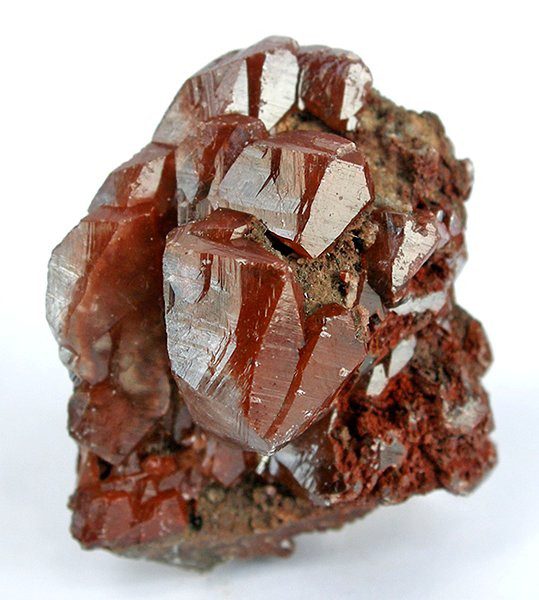
Calcite with clear and reddish-brown hematite zoning, Tsumeb.
Photo: Robert M. Lavinsky · CC BY-SA 3.0 · Source

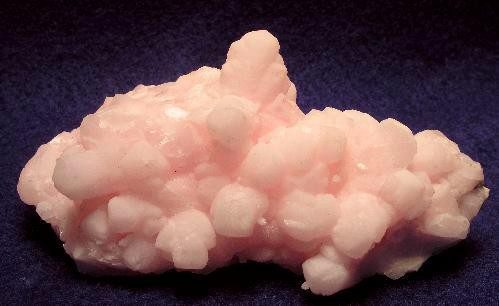
Rich-pink manganoan calcite with organic-like habit, Wessels Mine.
Photo: Robert M. Lavinsky · CC BY-SA 3.0 · Source

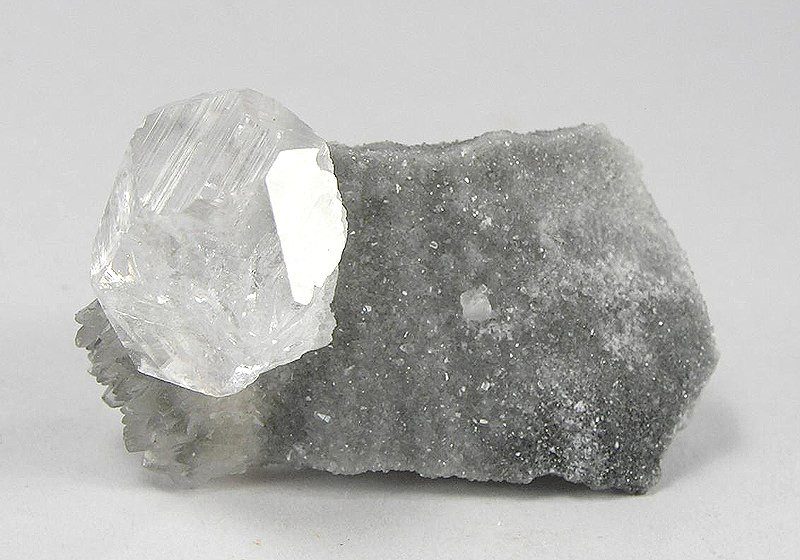
Sharp glassy calcite crystal on a matrix shard from the Huarón mines.
Photo: Robert M. Lavinsky · CC BY-SA 3.0 · Source

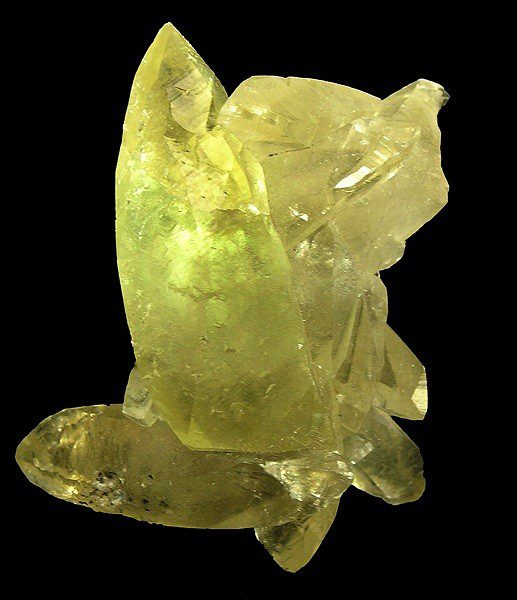
Golden calcite cluster with a phantom, Sweetwater Mine, Viburnum Trend.
Photo: Robert M. Lavinsky · CC BY-SA 3.0 · Source

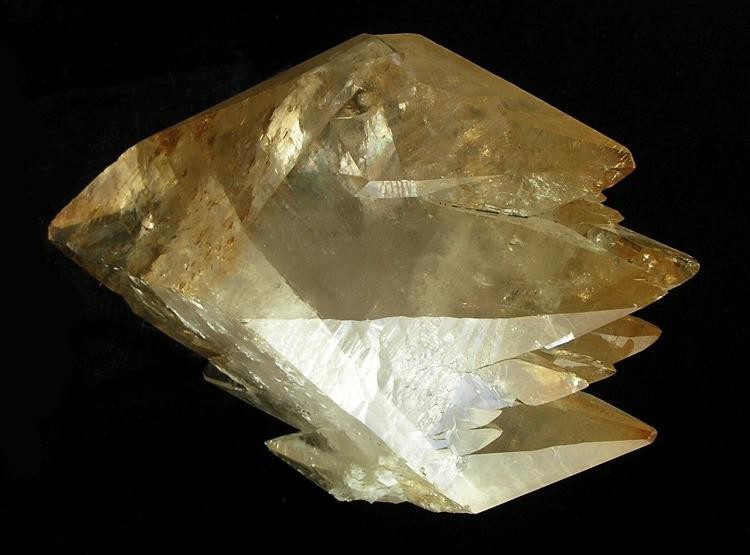
Amber doubly terminated twinned calcite with a cluster of shark's-tooth crystals, Elmwood mine.
Photo: Robert M. Lavinsky · CC BY-SA 3.0 · Source

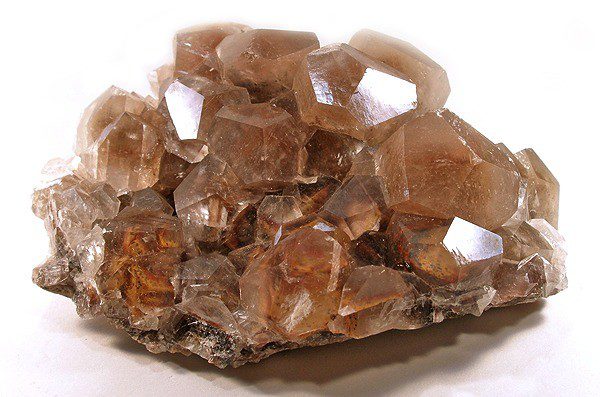
Pyramidal calcite crystals with phantoms, Leiping mine.
Photo: Robert M. Lavinsky · CC BY-SA 3.0 · Source

Where Calcite is found (6)
China
- Leiping Mine (Guiyang County, Chenzhou)Hunan · 1 photo
Namibia
- Tsumeb MineOshikoto Region · 2 photos
Peru
- Huarón Mine (Huarón Mining District)Pasco · 1 photo
South Africa
- Wessels Mine (Kalahari manganese field, near Hotazel)Northern Cape · 1 photo
United States
- Elmwood Mine (Carthage, Smith County)Tennessee · 1 photo
- Viburnum TrendMissouri · 1 photo
Calcite on the same specimen with other minerals
1 specimen photo(s) from this locality show marcasite with calcite together. The pairing comes from the photographer's file name and label, so the relationship between the two minerals is not specified.
1 specimen photo(s) from this locality show marcasite with calcite together. The pairing comes from the photographer's file name and label, so the relationship between the two minerals is not specified.
1 specimen photo(s) from this locality show chalcopyrite with calcite together. The pairing comes from the photographer's file name and label, so the relationship between the two minerals is not specified.
1 specimen photo(s) from this locality show galena with calcite together. The pairing comes from the photographer's file name and label, so the relationship between the two minerals is not specified.
1 specimen photo(s) from this locality show galena with calcite together. The pairing comes from the photographer's file name and label, so the relationship between the two minerals is not specified.
1 specimen photo(s) from this locality show galena with calcite together. The pairing comes from the photographer's file name and label, so the relationship between the two minerals is not specified.
1 specimen photo(s) from this locality show vanadinite with calcite together. The pairing comes from the photographer's file name and label, so the relationship between the two minerals is not specified.
1 specimen photo(s) from this locality show vanadinite with calcite together. The pairing comes from the photographer's file name and label, so the relationship between the two minerals is not specified.
1 specimen photo(s) from this locality show sphalerite with calcite together. The pairing comes from the photographer's file name and label, so the relationship between the two minerals is not specified.
1 specimen photo(s) from this locality show dolomite with calcite together. The pairing comes from the photographer's file name and label, so the relationship between the two minerals is not specified.
2 specimen photo(s) from this locality show siderite with calcite together. The pairing comes from the photographer's file name and label, so the relationship between the two minerals is not specified.
2 specimen photo(s) from this locality show siderite with calcite together. The pairing comes from the photographer's file name and label, so the relationship between the two minerals is not specified.
1 specimen photo(s) from this locality show rhodochrosite with calcite together. The pairing comes from the photographer's file name and label, so the relationship between the two minerals is not specified.
1 specimen photo(s) from this locality show rhodochrosite with calcite together. The pairing comes from the photographer's file name and label, so the relationship between the two minerals is not specified.
1 specimen photo(s) from this locality show rhodochrosite with calcite together. The pairing comes from the photographer's file name and label, so the relationship between the two minerals is not specified.
1 specimen photo(s) from this locality show rhodochrosite with calcite together. The pairing comes from the photographer's file name and label, so the relationship between the two minerals is not specified.
2 specimen photo(s) from this locality show rhodochrosite with calcite together. The pairing comes from the photographer's file name and label, so the relationship between the two minerals is not specified.
1 specimen photo(s) from this locality show rhodochrosite with calcite together. The pairing comes from the photographer's file name and label, so the relationship between the two minerals is not specified.
Identity
- Group
- Calcite Group
- Strunz
- 5.AB.05 · 5 Carbonates and nitrates
- IMA status
- Grandfathered
- Name origin
- From the Latin 'calx' (lime), via German 'Calcit', alluding to its use in making lime.
- Elements
- Ca, C, O
Physical properties
- Color
- Colorless or white; also gray, yellow, green and many other colors caused by included minerals
- Streak
- White
- Luster
- Vitreous luster
- Transparency
- Variable
- Mohs hardness
- 3
- Density
- 2.71 g/cm³
- Cleavage / fracture
- Perfect rhombohedral cleavage {10-11} in three directions (about 74.9 degrees); fracture conchoidal; brittle
- Magnetism / fluorescence
- Fluoresces red, blue, yellow and other colors under short- and long-wave UV; may phosphoresce
Crystallography
- Crystal system
- Trigonal
- Space group
- R-3c
- Typical habit
- Rhombohedral, scalenohedral ('dogtooth'), prismatic or tabular crystals (over 1000 forms recorded); also stalactitic, botryoidal, granular and massive
- Twinning
- Common, on {01-12}, {10-11}, {0001} and {02-21}
- Optical data
- Uniaxial (-), anomalously biaxial; omega about 1.658, epsilon about 1.486; very strong birefringence and dispersion
Formation and use
- Formation
- Major rock-forming mineral of limestone, marble and chalk; common cement in sedimentary rocks; gangue in low-temperature hydrothermal veins; also in alkaline to mafic igneous rocks, in vesicles with zeolites, and as speleothems in caves.
- Uses
- Lime and cement raw material, building stone, filler (for example in paper), optical components (Iceland spar), and collector specimens.
- Stability and care
- Dissolves with effervescence in dilute acids, so keep acids and acidic cleaners away from specimens.
Related minerals
- Related minerals
- Rhodochrosite (solid-solution series)dolomite
- Polymorphs
- Aragonitevaterite
- Can be confused with
- Dolomitearagonite
Sources
- SRC-184 · Book
Handbook of Mineralogy - CalciteAnthony, J.W.; Bideaux, R.A.; Bladh, K.W.; Nichols, M.C. · Mineralogical Society of America - SRC-185 · Website
CalciteWikipedia contributors · Wikipedia
Draft data from the Provenite workbook. Check entries against the cited sources before relying on them. Photos are open-licence images from Wikimedia Commons; the author and licence are given with each photo.