About Bornite
Cu₅FeS₄
A copper-iron sulfide with about 63% copper, known as peacock ore for the iridescent purple and blue tarnish that quickly forms on its copper-red to brown fresh surfaces. Well-formed crystals are uncommon; most bornite is massive ore.
Photos of Bornite
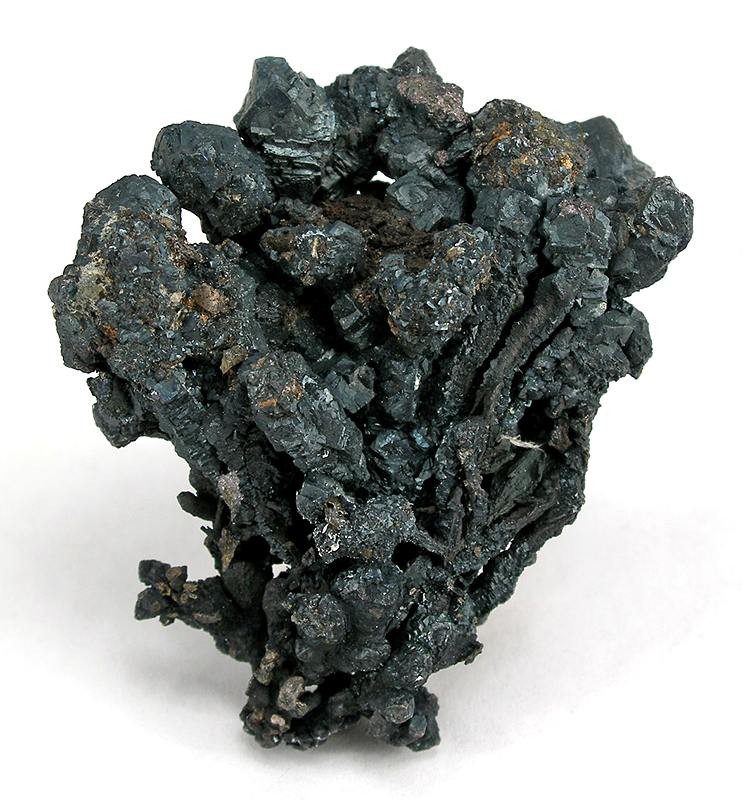
Tree-like cluster of thick, elongated bornite crystals from the Carn Brea Mine.
Photo: Robert M. Lavinsky · CC BY-SA 3.0 · Source

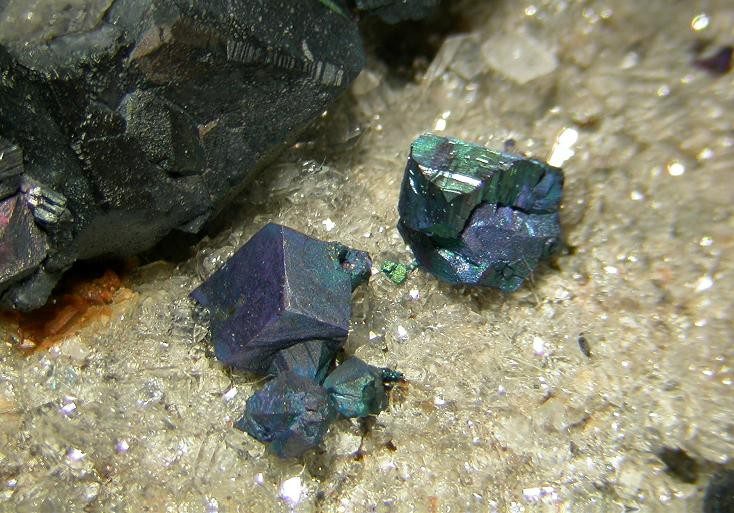
Close-up of bornite crystals from the Dzhezkazgan Mine, field of view 9 mm.
Photo: Leon Hupperichs · CC BY-SA 3.0 · Source

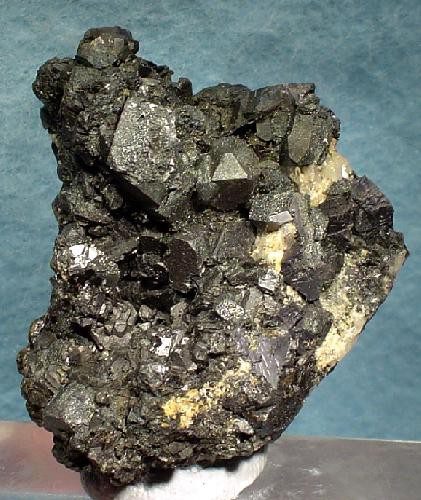
Cluster of sharp dodecahedral steel-gray bornite crystals on quartz from Butte.
Photo: Robert M. Lavinsky · CC BY-SA 3.0 · Source

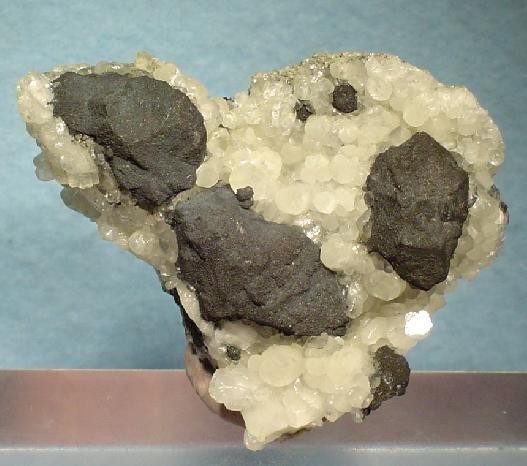
Three large discrete bornite crystals on a quartz plate from the Leonard Mine.
Photo: Robert M. Lavinsky · CC BY-SA 3.0 · Source

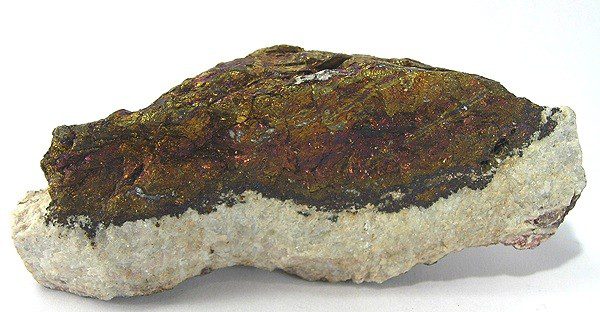
Iridescent massive bornite on matrix from the Cole Mine, Bisbee.
Photo: Robert M. Lavinsky · CC BY-SA 3.0 · Source

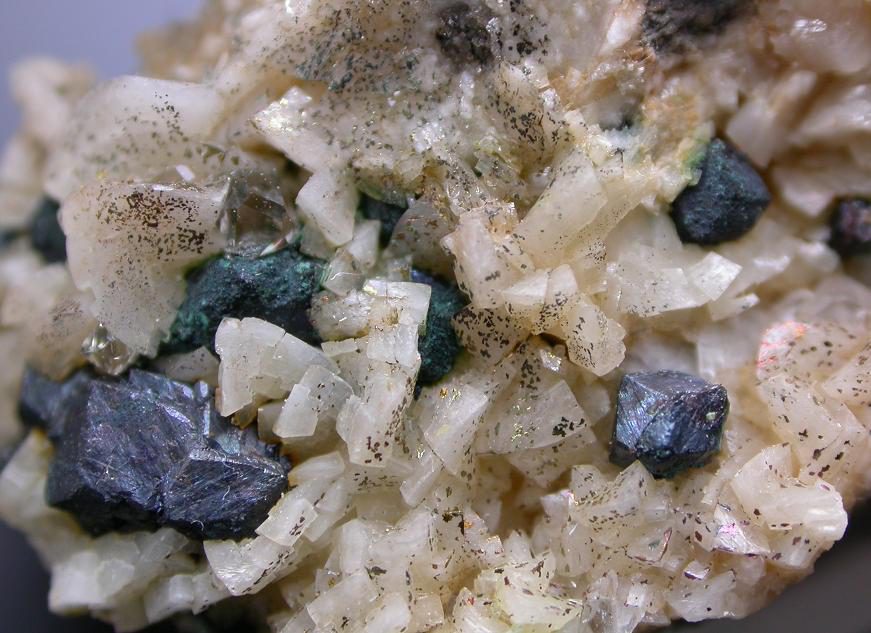
Bornite from the Kupferschiefer of the Thomas Muentzer shaft, Sangerhausen, field of view 20 mm.
Photo: Leon Hupperichs · CC BY-SA 3.0 · Source

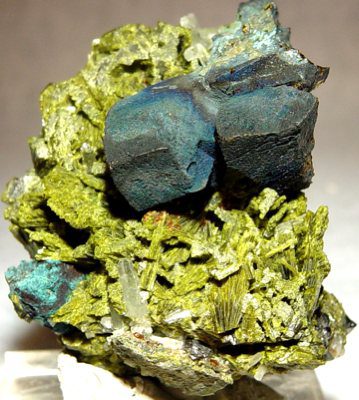
Chalcopyrite crystals coated with bornite on epidote from the Dashkesan deposit.
Photo: Robert M. Lavinsky · CC BY-SA 3.0 · Source

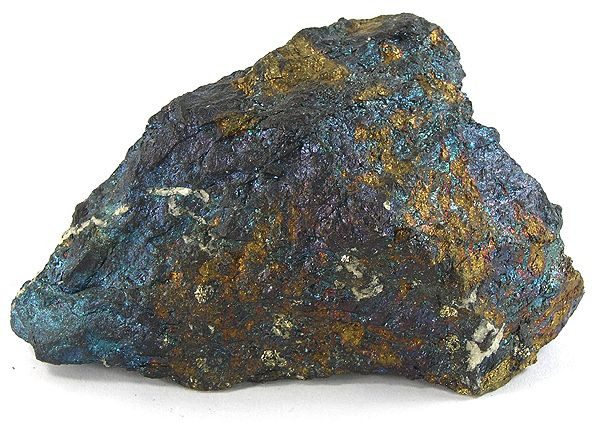
Large piece of massive bornite with gold, blue and purple iridescence from the Lavender Pit, Bisbee.
Photo: Robert M. Lavinsky · CC BY-SA 3.0 · Source

Where Bornite is found (11)
Azerbaijan
- Dashkesan Co-Fe depositDashkasan District · 1 photo
Germany
- Thomas Muentzer Shaft (Schacht Sangerhausen)Saxony-Anhalt · 1 photo
Kazakhstan
- Dzhezkazgan Mine (Zhezkazgan)Ulytau Region · 4 photos
Peru
- Huarón Mine (Huarón Mining District)Pasco · 1 photo
United Kingdom
- Carn Brea MineCornwall · 5 photos
United States
- Butte Mining DistrictMontana · 3 photos
- Cole Mine (Cole shaft), BisbeeArizona · 1 photo
- Copper Queen MineArizona · 1 photo
- Flambeau MineWisconsin · 1 photo
- Lavender PitArizona · 1 photo
- Leonard MineMontana · 2 photos
Bornite on the same specimen with other minerals
2 specimen photo(s) from this locality show sphalerite with bornite together. The pairing comes from the photographer's file name and label, so the relationship between the two minerals is not specified.
1 specimen photo(s) from this locality show siderite with bornite together. The pairing comes from the photographer's file name and label, so the relationship between the two minerals is not specified.
2 specimen photo(s) from this locality show bornite with quartz together. The pairing comes from the photographer's file name and label, so the relationship between the two minerals is not specified.
1 specimen photo(s) from this locality show bornite with quartz together. The pairing comes from the photographer's file name and label, so the relationship between the two minerals is not specified.
1 specimen photo(s) from this locality show bornite with pyrite together. The pairing comes from the photographer's file name and label, so the relationship between the two minerals is not specified.
1 specimen photo(s) from this locality show bornite with quartz together. The pairing comes from the photographer's file name and label, so the relationship between the two minerals is not specified.
2 specimen photo(s) from this locality show bornite with quartz together. The pairing comes from the photographer's file name and label, so the relationship between the two minerals is not specified.
1 specimen photo(s) from this locality show bornite with chalcopyrite together. The pairing comes from the photographer's file name and label, so the relationship between the two minerals is not specified.
1 specimen photo(s) from this locality show bornite with pyrite together. The pairing comes from the photographer's file name and label, so the relationship between the two minerals is not specified.
1 specimen photo(s) from this locality show bornite with chalcopyrite together. The pairing comes from the photographer's file name and label, so the relationship between the two minerals is not specified.
Identity
- Also called
- peacock ore; peacock copper
- Strunz
- 2.BA.10 · 2 Sulfides and sulfosalts
- IMA status
- Grandfathered
- Name origin
- Named in 1845 in honour of the Austrian mineralogist Ignaz Edler von Born (1742-1791).
- Elements
- Cu, Fe, S
Physical properties
- Color
- Copper-red to pinchbeck-brown on fresh surfaces; tarnishes rapidly to iridescent purple and blue
- Streak
- Pale grayish black
- Luster
- Metallic luster
- Transparency
- Opaque
- Mohs hardness
- 3–3.25
- Density
- 5.06–5.08 g/cm³
- Cleavage / fracture
- Cleavage on {111} in traces; fracture uneven to subconchoidal; brittle
- Magnetism / fluorescence
- Magnetic after heating; non-fluorescent
Crystallography
- Crystal system
- Orthorhombic
- Space group
- Pbca
- Structure
- Pseudocubic orthorhombic superstructure; a = 10.950, b = 21.862, c = 10.950 Å, Z = 16. Intermediate and high-temperature forms exist above the stability field of the low form.
- Typical habit
- Pseudocubic, dodecahedral or octahedral crystals up to 6 cm; most commonly granular, compact, massive or disseminated
- Twinning
- On {111}; penetration twins common
- Optical data
- Opaque; pinkish brown in polished section when fresh; weak but noticeable pleochroism; weak anisotropy
Formation and use
- Formation
- Disseminated in mafic igneous rocks, in contact-metamorphic skarns, in pegmatites, in medium- to high-temperature hydrothermal deposits and in sedimentary cupriferous shales; the low form is stable below about 200 °C. Associated with chalcopyrite, pyrite, other Cu-Fe sulfides, garnet, calcite, wollastonite and quartz.
- Uses
- Important ore of copper; collector specimens.
- Stability and care
- Fresh surfaces tarnish rapidly to iridescent purple and blue colours.
Related minerals
- Related minerals
- Digenitechalcopyrite
Sources
- SRC-664 · Book
Handbook of Mineralogy - BorniteAnthony, J.W.; Bideaux, R.A.; Bladh, K.W.; Nichols, M.C. · 2005 · Mineral Data Publishing / Mineralogical Society of America - SRC-665 · Database
Bornite Mineral DataBarthelmy, D. · Webmineral.com - SRC-666 · Website
BorniteWikipedia contributors · Wikipedia
Draft data from the Provenite workbook. Check entries against the cited sources before relying on them. Photos are open-licence images from Wikimedia Commons; the author and licence are given with each photo.