About Rock crystal
SiO₂
Rock crystal is the colourless variety of quartz. Its lack of colour reflects the absence of colour-causing impurities and colour centres. It is the clear counterpart of smoky quartz, amethyst and citrine. Synthetic hydrothermal quartz is also made as colourless crystal, so provenance matters.
Photos of Rock crystal
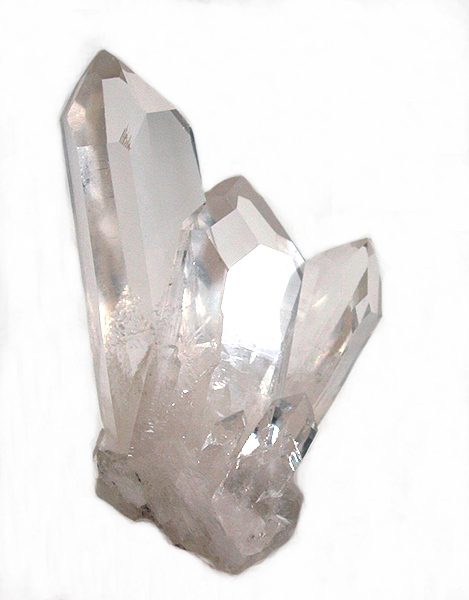
Group of colorless, transparent quartz crystals in graduated ascending rows (specimen from Madagascar).
Photo: Robert M. Lavinsky · CC BY-SA 3.0 · Source

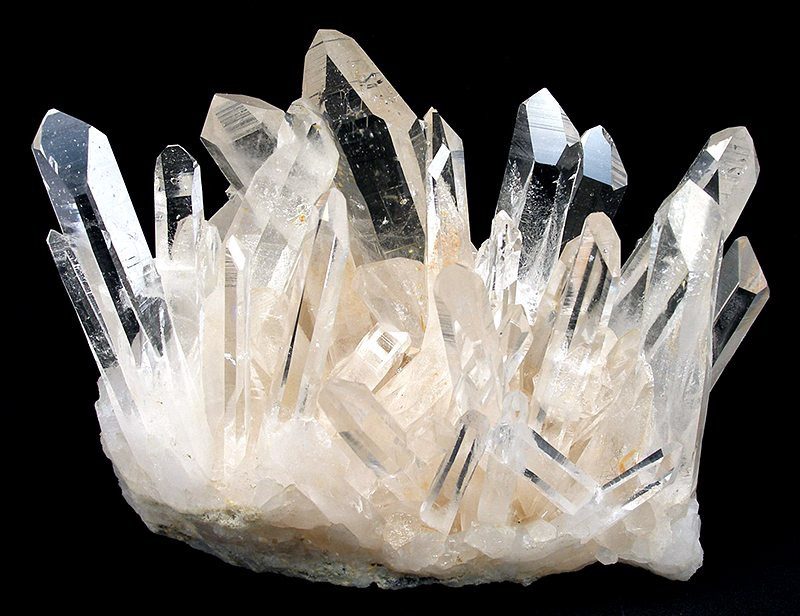
Dense cluster of water-clear quartz points rising from a thin matrix plate (specimen from East Coleman Mine, Jessieville, Garland County, Arkansas, USA).
Photo: Robert M. Lavinsky · CC BY-SA 3.0 · Source

Where Rock crystal is found (7)
Greenland
- IgalikuKujalleq
Hungary
- Gyöngyösoroszi (Altáró)Heves County
Madagascar
- Madagascar · 1 photo
Switzerland
United States
- East Coleman MineArkansas · 1 photo
- Middleville (Herkimer diamond district)New York
- Wegner Quartz Crystal MinesArkansas
Identity
- Variety of
- Quartz
- Also called
- Colourless quartz
- Strunz
- 4.DA.05 · 4 Oxides and hydroxides
- IMA status
- Variety
- Name origin
- From Greek kristallos (crystal); the ancient Greeks, including Theophrastus, used the name for clear quartz, which was believed to be permanently frozen ice.
- Elements
- Si, O
Physical properties
- Color
- Colourless
- Luster
- Vitreous luster
- Transparency
- Transparent
- Mohs hardness
- 7
- Density
- 2.65–2.66 g/cm³
- Cleavage / fracture
- Cleavage rarely observable and poor on {10-11}, {01-11} and {10-10}; rhombohedral parting; fracture conchoidal
Crystallography
- Crystal system
- Trigonal
- Space group
- P3₁21 or P3₂21
- Typical habit
- Prismatic crystals with rhombohedral terminations; also doubly terminated crystals (for example Herkimer type) and large cleft crystals and clusters
- Twinning
- Very common: Dauphiné and Brazil penetration twins, Japan contact twins
- Optical data
- Uniaxial (+); omega = 1.544, epsilon = 1.553
Formation and use
- Formation
- Found in Alpine fissures (clefts) in granitic massifs, in sandstone-hosted hydrothermal veins, in vugs in carbonate rock (dolostone), and in sulfide-bearing hydrothermal veins. Alpine cleft crystals grow slowly over millions of years from metamorphic fluids as the Alps rise and cool toward about 200 degrees C.
- Uses
- Used since prehistoric times for cutting tools and from the Middle Ages for carved objects such as monstrances and reliquaries (workshops in Milan, Venice, Prague, Freiburg); quartz in general serves in frequency standards and optical instruments; collector's specimens.
- Stability and care
- Natural rock crystal needs no treatment to be colourless, so the main concern is synthetic material, which is grown in large, high-quality pieces. A reliable separation uses infrared spectroscopy: natural rock crystal shows absorptions near 3379, 3483 and 3595 cm-1 that synthetic quartz never shows. Nail-head spicules and breadcrumb-like inclusions are typical of hydrothermal synthetics, while Brazil-law twinning points to natural origin.
Related minerals
- Related minerals
- Quartzsmoky quartzamethystcitrineprasioliterose quartz
- Can be confused with
- Synthetic (hydrothermal) colourless quartz
Sources
- SRC-084 · Book
Handbook of Mineralogy - QuartzAnthony, J.W.; Bideaux, R.A.; Bladh, K.W.; Nichols, M.C. · 2001 · Mineralogical Society of America / Mineral Data Publishing - SRC-085 · Database
Quartz (Mindat.org mineral page)Mindat.org / Hudson Institute of Mineralogy - SRC-134 · Article
Quartz crystals from alpine fissures: their formation and the historical significance of alpine quartz as raw material for objets d'artHuegi, M.F. · 2023 · 37th International Geological Congress (IGC), Tokyo - SRC-139 · Website
Herkimer diamondsKing, H.M. · Geology.com - SRC-144 · Article
Synthetic Rock Crystal Quartz Bangle with Unusual InclusionsNg-Pooresatien, N. · 2015 · Gems & Gemology, Winter 2015, Lab Notes
Draft data from the Provenite workbook. Check entries against the cited sources before relying on them. Photos are open-licence images from Wikimedia Commons; the author and licence are given with each photo.